


This is a vital update. There’s a much longer Renaissance Report in the works on the polycrisis we’re facing, but I couldn’t wait any longer to get this information out to you.
With the Iran war spiraling out of control, and with the inability of Russia to defend its refineries and even its Wildberries warehouses (Russia’s Amazon equivalent) under devastating attacks, the economic fallout from just the loss of crude oil, natural gas, and refined oil products will range from severe to catastrophic, depending on how much longer the disruptions to supplies last.
I’ve been working on covering the Iran and Russian situations since I first issued an ALERT on February 27 – before the war with Iran had even begun. That’s 144 days straight without a break. Lots of content, and now it’s time to take a deeper dive into the reasons I am so alarmed at the direction events are currently taking.
I am hereby formally extending my war & economic ALERT for a third time. For subscribers, I will go into that in greater detail in the second part of this report. For everyone else, be sure that you are as stocked up as you can be with water, a year’s worth of stored food, home energy generation and batteries, the ability to defend your family and property, plenty of ammo, medicine, and anything else your particular circumstances require.
The Economy and Money
As I detailed in Volume 1 of The Renaissance Report, what we call money is actually bank credit. That means that all of our money is loaned into existence.
Top-shelf economist Richard Werner explains that to Tucker Carlson and us all in just 16 seconds:
Any bank creates money. When you take out a loan, the money you are given as the borrower didn’t previously exist. It is net new purchasing power that’s been added to the money supply, and that’s how the system works.
There’s one more feature of such a system; the interest to pay back the loan is not created at the time of the loan. Ah, so where does that money come from?
Well, that too has to be loaned into existence. Run that debt-interest cycle for a few turns, and you’ll quickly discover that our entire system of money, and by extension every facet of what we call our economy, is actually dependent on a system that has to not only grow perpetually larger, but exponentially larger.
The greatest shortcoming of the human race is our inability to understand the exponential function.
~ Professor Al Bartlett
You can actually see this in action if you look at the total amount of debt in the U.S. It is not a linear accumulation over time, but an exponential explosion.
Federal debt has added $3.5 trillion over the past 12 months, where it took all of U.S. history from its founding until 1991 to accumulate its first $3.5 trillion.
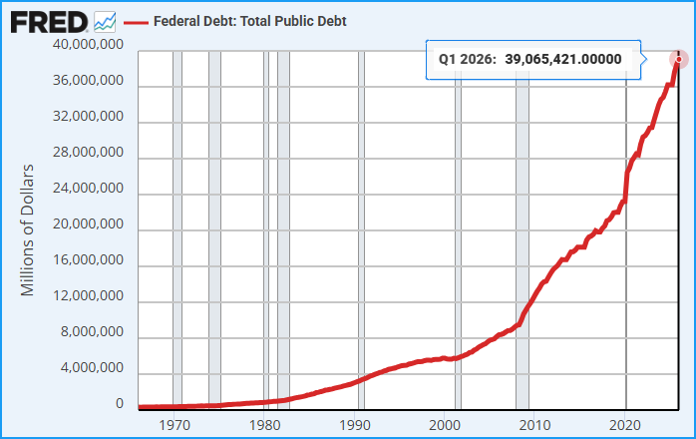
Faster and faster is a hallmark of an exponential function. While the rate may remain seemingly sedate, say steadily compounding at 5% per year, the amount of stuff piling up explodes higher with every passing year.
More broadly, the entirety of the U.S. economy is now saddled with over $115 trillion of debt. This, too, is a nearly perfect exponential chart. Where it took all of U.S. history until the year 2000 to build-up $30 trillion of total debt, that much has been added to the pile since 2020, when COVID first hit.
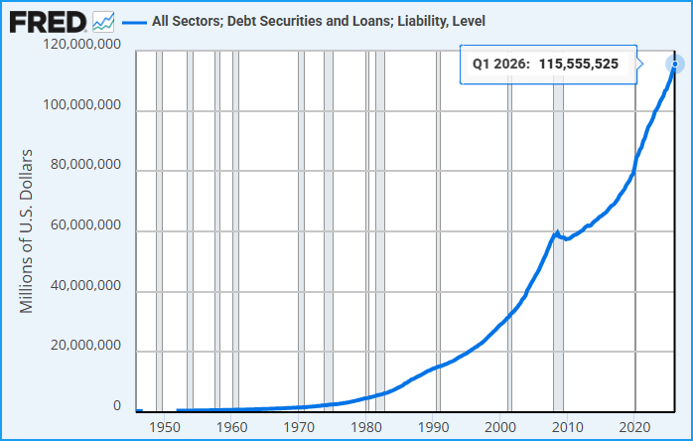
There’s an important clue hidden in the above chart, and it’s that little wiggle right around 2010. That’s the Great Financial Crisis, and it’s the only time in the entire credit series where debt actually went backwards for a few quarters in a row.
That very nearly destroyed the entire financial system and scared the Fed and Wall Street half to death. They won’t be making that mistake again. (Spoiler: get ready for more printing and inflation).
I’ve covered all of these dynamics in far greater detail elsewhere, but I wanted to be sure I set the stage so we’re all on the same page.
Just hold this thought in mind; we have put all of our economic eggs in a system of money that is either happily expanding exponentially, or it is busy collapsing. It doesn’t seem to have a steady state that anybody can locate or activate.
The Economy and Energy
Now it’s time to tie money and the economy to energy. This is the part nearly every economist either misses or doesn’t know about, and it’s absolutely the most vital.
Here’s why. In those charts of debt growth above, three are both implicit and explicit assumptions on display. Explicitly, every lender hopes to be paid back. Banks and financial institutions do not lend money if they think it won’t be paid back.
Since debt is a claim on one’s future income, an implicit assumption baked right into a steadily (if not alarmingly) expanding pile of debt is that the future economy will be much larger than the present and be spitting out gobs of free cash flows to pay off the debts.
But a debt chart that never reduces and always grows? Ah, that makes the implicit assumption that there will not be any end to economic growth. It will always be there.
This is where the rubber really hits the road.
We can get to the heart of the matter by observing that there’s no such thing as a low-energy rich country, or a high-energy-consuming poor country:
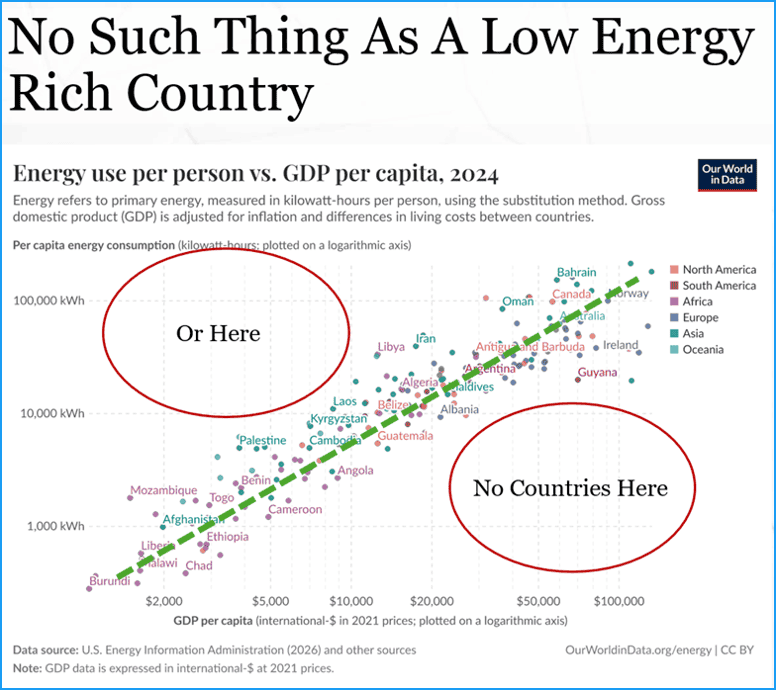
If it were possible to burn a lot of energy and remain poor, some sad-sack country would have worked that out by now. Or have figured out how to be totally wealthy while burning less energy. But we don’t see either of those things.
So the observation is as obvious as it is overlooked; one’s living standards are determined by how much energy is used by one’s country. Which means we’d probably better keep a really close eye on our energy supplies, how much of them are left, and maintain access to those that do remain.
More reductively, we can put the relationship between the economy and energy like this:
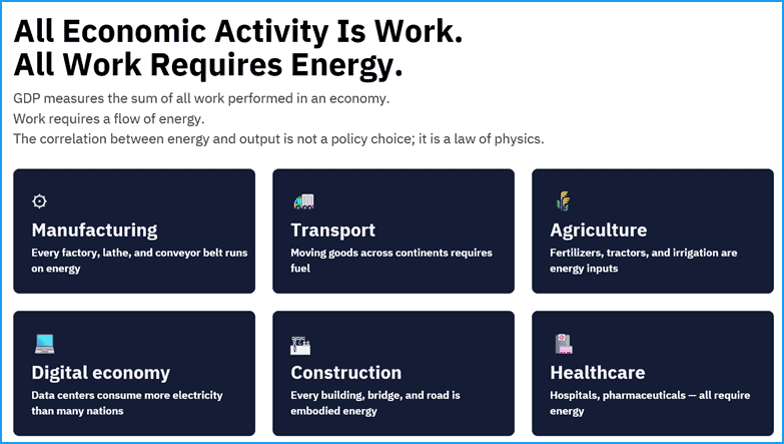
All economic activity – I don’t care what you think of – requires work. And all work requires energy. This means we’re down to this thing called reality, which is immutably anchored by physics.
I know that as a nation we’ve strayed away from respecting, if not honoring reality, often preferring powerful narratives instead, but it cannot be ignored forever.
Risking Economic Collapse
Crude oil is what runs the world’s economy. Not butane, not propane, and not ethane. Although these are very useful molecules, they do not power our ships, jets, or trucks.
I raise this distinction because, for some reason, the main oil tracking and reporting agencies (the EIA and IEA) began smashing all the hydrocarbons into one messy bucket they now call “petroleum.”
This is confusing to a guy my age because when I grew up, petroleum was synonymous with oil. But, as happened with Covid and ‘vaccine’ suddenly having its definition changed midstream, petroleum suddenly meant anything made of carbon and hydrogen that came out of the ground.
So, we have to perform the extra step of backing these non-oil hydrocarbons out of the equation. When we do, we find that the world was producing and consuming 86 million barrels of oil per day (mb/d).
With the recent closures of the Strait of Hormuz and the Bab el-Mandeb Strait, and Russia’s losses, the world is missing approximately 12 million barrels per day (mb/d).
Some math: 86 – 12 = 74.
That would place the world’s current oil output at the same level it was at in 2011:
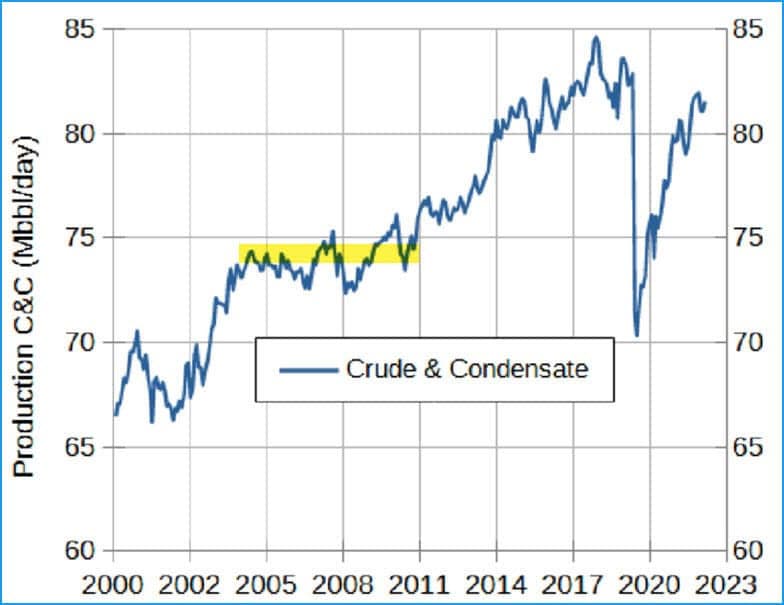
Since we now know together that energy = economy, and oil is The Master Resource in that economic equation, we are free to ask, “Well, okay, how big was the world economy in 2011?”
The answer: in 2011, the global economy was 36% smaller.
In other words, if the situations with Iran and Russia aren’t sorted out quickly, the world is facing an economic contraction that would make the Great Depression look tame. Only this time with extra debt and derivatives to fuel the descent.
Trump and the neocons are risking a true economic catastrophe. Prudent people are preparing.
Molecules Rule!
We live by a lot of fictions in the U.S., specifically, and the West (of late) more generally, but perhaps none have been quite as damaging as allowing our capital markets to become captives to speculators and a clutch of powerful insiders. Over time, they seem to have convinced themselves that as long as they can rig prices for financial assets, they can dodge reality and keep the consequences at bay forever.
Along the way, they’ve managed to create the most hideous wealth inequality on record. This is the 0.00001% vs. everybody else:
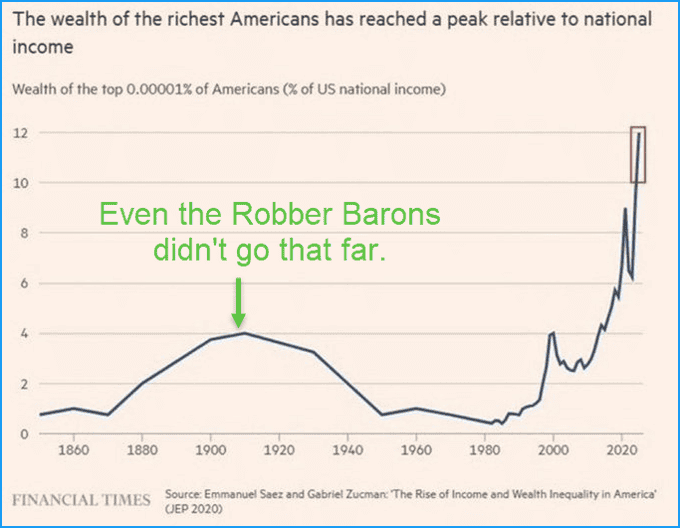
As Plutarch said, “The oldest and most fatal ailments of all republics is a gap between the rich and the poor.”
What I’m getting at here is that the constant rigging of the financial markets for the benefit of an increasingly tiny set of elites is a delusional narrative. It pretends that this is both a desirable as well as durable arrangement when it is neither.
Fictions are fictions.
But molecules are reality itself. You either have them or you don’t.
Here’s the oil business in as few words as I can muster: Hydrocarbons are wrestled from the ground, stored for a bit, and then set on fire.
Sure, we do other things with it besides put it in engines. After some tricky chemical steps, we also spread it on agricultural fields or lose it to the environment in the form of microplastics. But in every use, it’s pretty much a single use. One and done.
Said a different way, oil and natural gas and all of their related downstream products are the study of stocks and flows. How much is coming out of the ground (flows), and how much do we have in reserve (stocks) as compared to daily use?
For all of my adult life, those stocks and flows have always been very carefully balanced. Very carefully.
But not since the Iran war started. For some reason, everything I thought I knew about how oil was priced went straight out the window. Worse, I never expected that our elected and appointed leaders would abandon all caution and allow our precious stocks to alarmingly plummet.
For my entire adult life, if crude stocks got below 55 days of supply, minor panics would set in, the price of oil would spike, causing more to come to market. Conversely, anything over 75 days of supply was ‘too much,’ and prices would adjust downward.
What is even happening here?
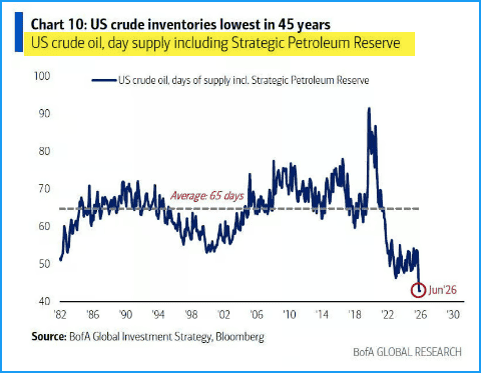
Did we just suddenly lose the plot? We’re skating on very thin ice here; it’s one thing to risk an explosive rise in prices, which would be damaging, but it’s entirely another to risk outright shortages.
How Much Time Is Left?
This is the most often asked question, and it is the least answerable. With any sort of precision that is. But we can plot the trajectories of current oil reserves and product inventories and confidently declare that we’ve got less than a year to sort all this out.
However, that’s at current rates of consumption. If prices suddenly spiked, demand would fall, and the timeline to ‘tank bottoms’ would stretch out longer. If, instead, prices are held steady, and demand remains far higher than supply (as is currently the case), then we probably only have until September or October until critical shortages erupt. This is the current path we are on, so unless something changes, my answer to “How much time is left?” is 2-3 months
One of the things I like about Trump is that when he speaks, he doesn’t have any filters (often causing the wonderfully pained expressions on the staffers flanking him). Let’s take a moment to enjoy this unfiltered moment from June 17:
“We run out of reserves in about four weeks.” “We would really run out, and there’ll be a time when you wouldn’t be able to get it…and you want to see bedlam?”
Did he let the cat out of the bag? I think so.
Now reserves are going to run out at different rates for different countries across the globe. Also, I should clarify that crude oil reserves and inventories, which are a different concept from diesel, gasoline, and jet fuel inventories. And that’s where the trouble is showing up.
Before I go into those, I should say that if refineries get damaged or destroyed in sufficient numbers, it’s entirely possible to have weak crude oil prices and sky-high refined product prices. With refineries offline, the produced crude has nowhere to go, leading to falling prices, and there’s also no downstream product, leading to thin inventories and higher prices.
With that said, as of July 21, 2026 there is a really big problem as exported ‘on the water’ diesel, gasoline and jet fuel are at historically very low levels and falling:
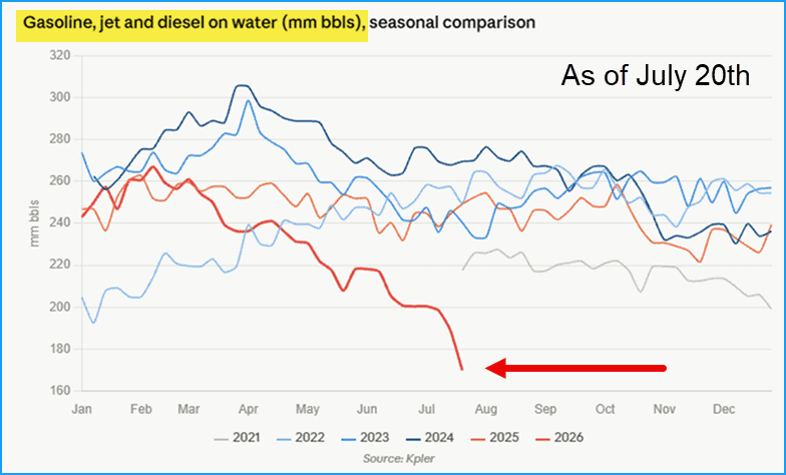
Plunging might be a better term. At the July rate of drawdown, should that continue, this chart plunges all the way to zero. In reality, inventories cannot get anywhere near the zero level before prices explode higher.
There are three main sources for ‘on the water’ fuels: the Persian Gulf countries exporting out of the Strait of Hormuz (SoH), Russia, and China.
The loss of shipped fuels from the SoH is stunning:
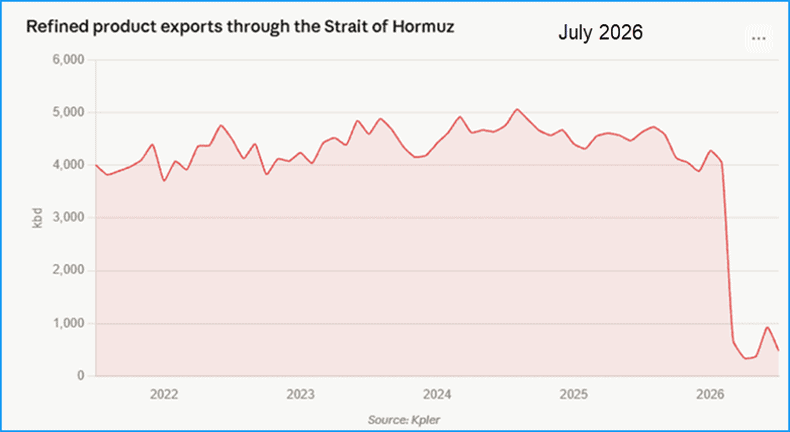
Roughly 4 million barrels per day of lost product. There are no signs of that resuming any time soon as of today (7/21/26).
Next, Russia has been absolutely clobbered, too, losing nearly 70% of its total refining capacity.
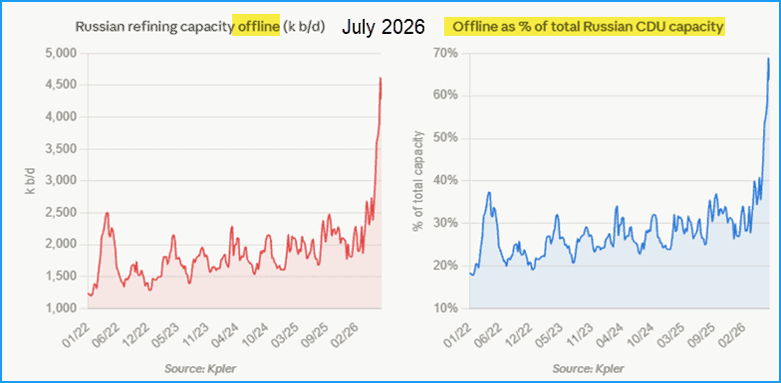
Russia has banned the export of diesel and now finds itself importing both diesel and gasoline. This is like waking up to read that Iowa has begun importing corn.
Finally, China had been exporting around 500,000 barrels per day, but has trimmed that back to a little under half that amount:
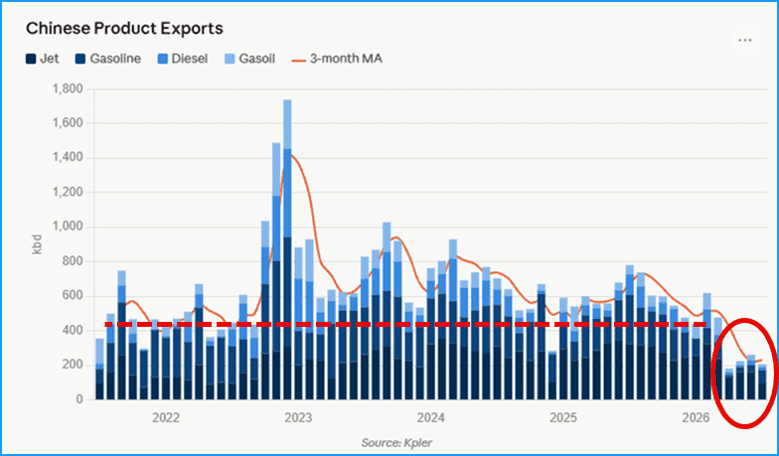
Back in the US, product inventories are all at or well below their five-year averages (red circles) while refinery demand is maxed out (green circle):
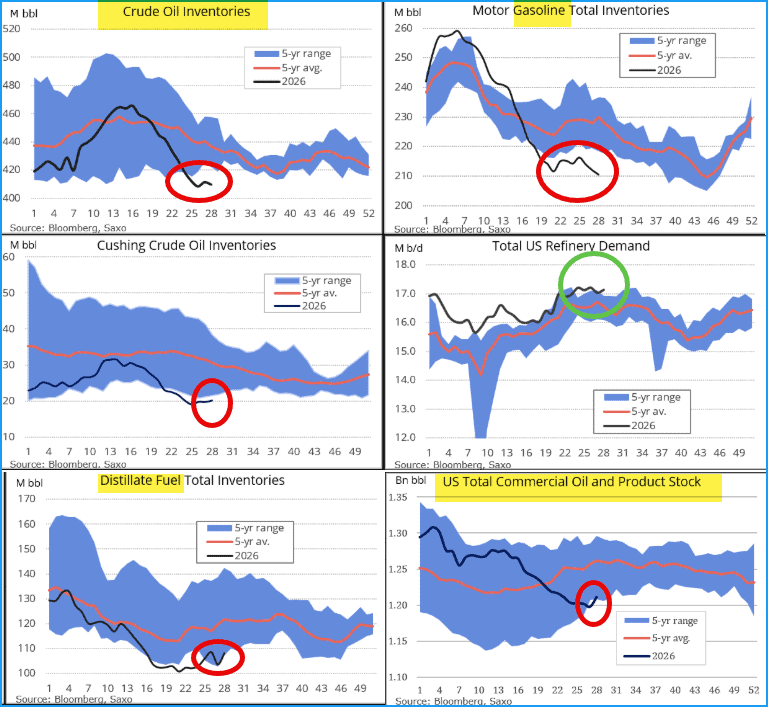
Inventories this low have always in the past led to sharply higher prices. I suspect this time will be no different, just with a delay. I will note that up here in New England, where I live, heating oil prices are up 84% from a year ago, which is going to cause considerable distress for many families and small businesses.
The summary is that, from an inventory standpoint, the US is currently in a weakened state. It wouldn’t take much to push things over the edge.
The Strait of Hormuz Is Closed Again, as is the Bab el-Mandeb Strait
I’ll get to the SoH in a second, but the big news here on July 21 is that the Bab el-Mandeb Straight has been effectively closed down by the Houthis, as promised and threatened.



 by irishprince