


It’s time once again for my quarterly review of all things oil-related with the top-shelf resource investor and analyst Adam Rozencwagj.
Like all of us, Adam has had to adjust his views of how the oil markets work given the massive gap between crude oil prices and oil products such as diesel. Adam’s view is that the oil crisis has been delayed, not permanently deferred.
The reasons are now better understood. First, there was the time buffer built into all of the oil ships already out of the Gulf when the war started, having to plod their way to their destinations. Second, there was a large release of oil from strategic reserves operating exactly as intended, buffering the shock. Third there was a “peace deal” surge of trapped oil tankers the suddenly exited the Gulf in June. Fourth was China’s unique ability to cut its imports by 40% to 50% while living off of its truly massive reserves.
But the hole in the global oil supply chain will not be easily or quickly remedied. Estimates put the missing barrels somewhere north of 2 billion barrels, with the head of Saudi Aramco recently placing it at 2.6 billion barrels.
The world has recently woken up to the idea that the real problem is in refined products rather than crude. Refinery disruptions in the Middle East, Russia, and especially China may have shifted the shortage downstream into gasoline, diesel and jet fuel. Poor visibility into global refined-product inventories makes this a major blind spot.
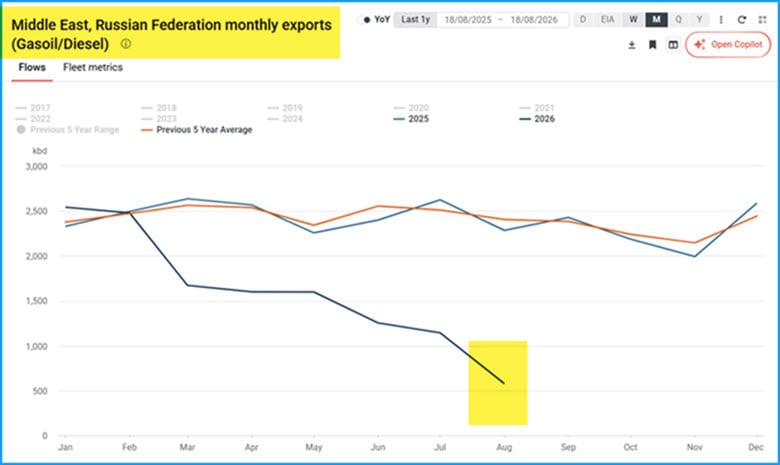
Alert observers have had to become familiar with ‘crack spreads’ and are tracking the price of diesel rather than crude. With the diesel crack spread having exploded from a normal $20-$30/barrel to over $100/barrel, diesel is selling as if oil were $70-$80 per barrel higher than is currently the case.
Diesel in New England
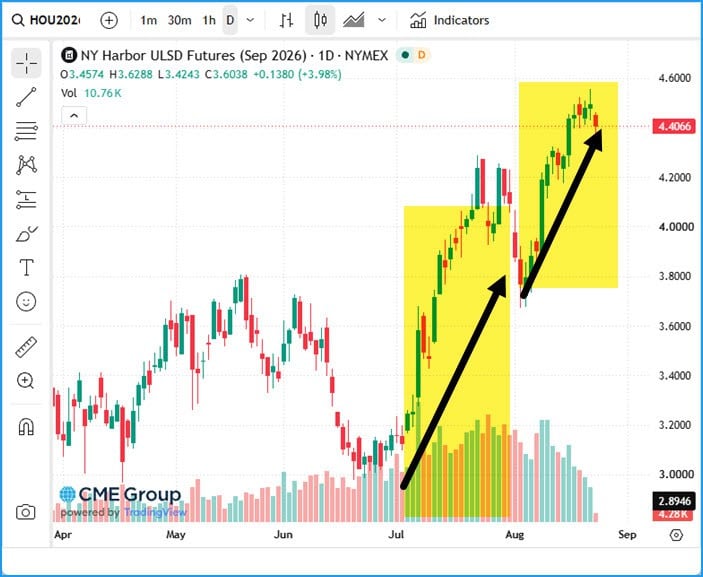
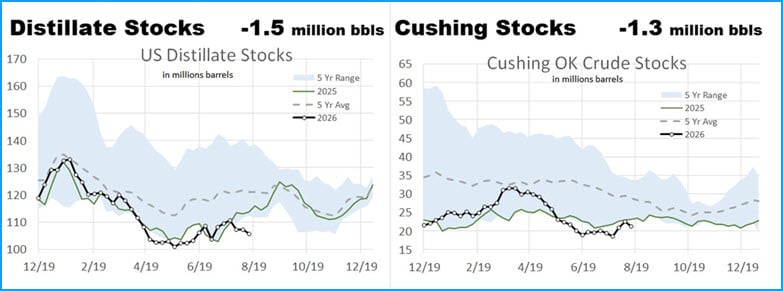
Meanwhile, there are no signs of demand destruction. Flights are actually up yr./yr. Roads are packed, and economies are still in growth mode. Supporting this is the fact that inventories are declining, which is a sure sign that demand is higher than supply.
In the background, Adam is truly an expert on the minutiae of where the US is in the shale oil story. And it’s the details that matter to investors (not oil traders).
The US shale boom has reached its limits, Adam convincingly argues. It was fun while it lasted, but the entire story now rests with one shale field, the Permian, and in just a small handful of counties within that play.
The subdued price for crude oil is, unhelpfully, causing a very lackluster response within the domestic oil production companies, with many of them either holding Capex steady or actually having reported they intend to reduce it this year and next.
Again, from an investment point, Adam noted that the opportunity here is that roughly $1.5 trillion per year for a decade may be needed to rehabilitate and recapitalize the global energy industry, compared with approximately $550 billion currently being spent.
If these funds do not materialize, then the world will have to find a way to live on less oil. It’s a matter of geology at this point.
Adam shared my long-held view that the only way for this to sort itself out is with much higher oil prices to both squash demand and stimulate production. But what if that price adjustment happens too quickly? That’s when financial market and economic chaos can result.
We also discussed the potential for the Iran and Russia wars to spill over into agriculture. Disruptions to phosphate, ammonia, urea, sulfur and LNG supplies are tightening fertilizer availability just as a potentially powerful El Niño threatens to increase weather volatility.
Food markets may be unusually vulnerable to even a modest agricultural shock. Global grain demand has risen substantially while recent crop yields have been exceptionally strong. But with drought already widespread and fertilizer availability constrained, a single poor growing season could have an outsized impact on prices.
Adam’s message is that dangerous complacency has somehow taken root in our financial markets. Are we living through the calm before the storm, or will it be the calm that deflects the storm?

Timestamps
00:00 The Crisis Isn’t Over Yet
01:54 Ten Million Barrels Vanish
03:45 Why Oil Inventories Aren’t What They Seem
06:03 From Oil Glut To Just-In-Time
08:00 The Market Stayed Dangerously Bearish
11:06 The Mystery Trader Theory
13:31 Why Inventories Took 50 Days To Fall
17:52 China’s Refinery Retreat Changes Everything
20:08 The Hidden Crisis In Refined Products
25:38 The Coming Oil Supply Shock
31:34 The Permian’s “Last Gasp” Of Gas
39:44 Why Shale Producers Aren’t Drilling
43:32 How Much SPR Oil Is Really Left?
46:41 Diesel Is Flashing Red
54:01 Oil May Be The Mispriced Asset
57:17 2027 Could Get Very Interesting
01:01:30 The Crisis May Be Worse Than It Looks
01:03:27 The Crisis Isn’t Over
FINANCIAL DISCLAIMER:
The information contained in this video and the resources available for download through our affiliated website are not intended as and shall not be understood or construed as financial advice, nor should be interpreted as a solicitation to sell or offer to sell investment advisory services. No person who currently works for or contracts with Peak Prosperity or Peak Financial Investing is an attorney or accountant, nor are we holding ourselves out to be, and the information contained in the video and on the website is not a substitute for legal or tax advice from a professional who is aware of the facts and circumstances of your individual situation. While Peak Financial Investing is a registered investment advisor, please note that this podcast is not intended to be investment advice.
All information has been obtained from sources believed to be reliable, but its accuracy is not guaranteed. There is no representation or warranty as to the current accuracy, reliability or completeness of, nor liability for, decisions based on such information and it should not be relied on as such. We have done our best to ensure that the information provided is accurate and provides what we feel is valuable information. The views expressed are subject to change based on market and other conditions.<
No guests or clients appearing on the podcast receive any form of compensation for their appearance and obtained no other benefit from either Peak Prosperity or Peak Financial Investing.
All investing involves risks including the possible loss of capital. Asset allocation and diversification does not ensure a profit or protect against loss. Please note that out- performance does not necessarily represent positive total returns for a period. There is no assurance that any investment strategy will be successful. All investments carry a certain degree of risk. Dividends are not guaranteed, and a company’s future ability to pay dividends may be limited.
Additional important disclosures for Peak Financial Investing may be found in our Form ADV Part 2A, which can be found at https://adviserinfo.sec.gov/firm/summary/319672.
 by cmartenson