Podcast




by
Adam Taggart
As older guys in our forties and fifties, Chris and I realize that we’re probably not the most compelling messengers to the Millenials and the generations behind them. So we’re constantly looking for others who can be.
In that vein, this short video below from Prince Ea recently caught our attention. It delivers a hard-hitting emotional call-to-action for sustainability and resilience using much of the same data we frequently cite here at Peak Prosperity.
Making It To The 4th Second
by Adam TaggartAs older guys in our forties and fifties, Chris and I realize that we’re probably not the most compelling messengers to the Millenials and the generations behind them. So we’re constantly looking for others who can be.
In that vein, this short video below from Prince Ea recently caught our attention. It delivers a hard-hitting emotional call-to-action for sustainability and resilience using much of the same data we frequently cite here at Peak Prosperity.



by
Chris Martenson
Executive Summary
- Why despite winning battle after battle, the central banks will lose the war
- The viscious cycle is already underway in the Emerging Markets
- Turkey
- Argentina
- Brazil and Mexico (not to mention Venezuela)
- Italy is dragging Europe into crisis
- The weaker segments in the US are already in collapse
If you have not yet read Part 1: The End Of Stimulus? (And The Start Of The Crash?), available free to all readers, please click here to read it first.
Suddenly everywhere we look in the emerging markets, we're seeing things quickly get out of hand. EM currencies are plunging and their bonds are being sold hard. It’s a broad-based sell-off.
Expect similar disruptions in the EM equity markets soon. The collapse progression is always the same: currency first, bonds second, then equites.
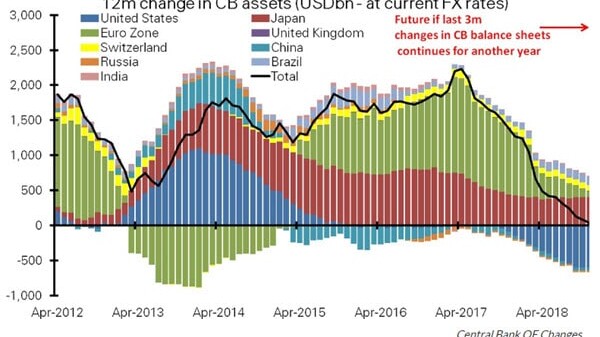
Our view of what’s happening in the EM universe is that the carry trades are unwinding. What this means is that the big piles of money unleashed on the world by the OECD central banks are turning tail and running away from the periphery (EMs) and back towards the core (US, EU).
The virtuous part of this cycle for the EM countries was that big funds would borrow in a major currency, like the dollar or euro, and then buy a particular EM currency (causing that currency to strengthen) as well as its debt (causing those bond prices to rise).
The opposite and unhappy part of that story is when that whole things gets reversed. A vicious cycle is initiated which causes the bonds of the EM country to be sold, jacking up EM interest rates, and then the currency is sold (weakening it), and then dollars/euros are bought again causing those major currencies to strengthen.
That’s the pattern we're seeing right now and it’s consistent with the falling global liquidity markets are experiencing, which indicates that a big problem is brewing.
For several EM countries, as well as weaker players in Europe and the American lower and middle classses, that problem has already arrived.
We see clear evidence of it in…
The Breaking Point Is Upon Us
PREVIEW by Chris MartensonExecutive Summary
- Why despite winning battle after battle, the central banks will lose the war
- The viscious cycle is already underway in the Emerging Markets
- Turkey
- Argentina
- Brazil and Mexico (not to mention Venezuela)
- Italy is dragging Europe into crisis
- The weaker segments in the US are already in collapse
If you have not yet read Part 1: The End Of Stimulus? (And The Start Of The Crash?), available free to all readers, please click here to read it first.
Suddenly everywhere we look in the emerging markets, we're seeing things quickly get out of hand. EM currencies are plunging and their bonds are being sold hard. It’s a broad-based sell-off.
Expect similar disruptions in the EM equity markets soon. The collapse progression is always the same: currency first, bonds second, then equites.
Our view of what’s happening in the EM universe is that the carry trades are unwinding. What this means is that the big piles of money unleashed on the world by the OECD central banks are turning tail and running away from the periphery (EMs) and back towards the core (US, EU).
The virtuous part of this cycle for the EM countries was that big funds would borrow in a major currency, like the dollar or euro, and then buy a particular EM currency (causing that currency to strengthen) as well as its debt (causing those bond prices to rise).
The opposite and unhappy part of that story is when that whole things gets reversed. A vicious cycle is initiated which causes the bonds of the EM country to be sold, jacking up EM interest rates, and then the currency is sold (weakening it), and then dollars/euros are bought again causing those major currencies to strengthen.
That’s the pattern we're seeing right now and it’s consistent with the falling global liquidity markets are experiencing, which indicates that a big problem is brewing.
For several EM countries, as well as weaker players in Europe and the American lower and middle classses, that problem has already arrived.
We see clear evidence of it in…
by
Chris Martenson
Back in January of 2016 we saw what appeared to be, and in my opinion should have been, the end of the Everything Bubble blown by the word's central banking cartel.
The carnage started in the emerging markets. Highly-leveraged positions and carry trades began to unwind. That's a fancy way of saying that all the big, sophisticated investors — who were busy borrowing heavily in countries with cheap money (the US, Japan, and Europe) and using that debt to speculate in markets offering higher yields (junk debt, emerging markets, stocks, etc.) — began to reverse their trades.
We are now seeing the same rapidly-deteriorating sequence in the markets today, here in late May 2018. And this time, it doesn't look like the central banks will be able to ride to the rescue as they have time and again over the past decade.
The End Of Stimulus? (And The Start Of The Crash?)
by Chris MartensonBack in January of 2016 we saw what appeared to be, and in my opinion should have been, the end of the Everything Bubble blown by the word's central banking cartel.
The carnage started in the emerging markets. Highly-leveraged positions and carry trades began to unwind. That's a fancy way of saying that all the big, sophisticated investors — who were busy borrowing heavily in countries with cheap money (the US, Japan, and Europe) and using that debt to speculate in markets offering higher yields (junk debt, emerging markets, stocks, etc.) — began to reverse their trades.
We are now seeing the same rapidly-deteriorating sequence in the markets today, here in late May 2018. And this time, it doesn't look like the central banks will be able to ride to the rescue as they have time and again over the past decade.
Total 6555 items