


Welcome to Episode #7 of the “Is It Too Late?” Series. Today we’re looking at the institutions that are supposed to protect our health, but inarguably often do the exact opposite. Can they be reformed or not?
Exploring this question starts with the observation that the COVID experience wasn’t really about health or public health at all. Every step taken was the opposite of what logic and observation would have indicated.
Instead, we can unravel the COVID responses to expose them as a series of exercises in expanding authoritarian power. Was this the actual ‘point’ of COVID? To see how much they could get away with?
Jeffrey Tucker, the Founder and President of the Brownstone Institute, was hot on the trail of the COVID story a full 15 years before it arrived. Of course, he didn’t know that at the time, but the planning for the avian flu under Bush is when the idea of systematic lockdowns accompanied by rushed vaccine development was first proposed.
The plans were made, fine-tuned, and waiting for something like COVID to come along.
During that waiting period, things like Event 201 were held where every facet of pandemic responses were discussed by members of the press, pharma, and the intelligence community. Well, everything except how to save lives.
Instead, they plotted how to control the narratives, combat vaccine hesitancy, and use media and social media to stifle questioning.
So, when COVID came along, the authoritarian pumps were primed and ready to spring into action.
One key problem with this “pandemic” was that very early on, even the CDC knew that COVID wasn’t really very deadly at all for healthy people under the age of 70:
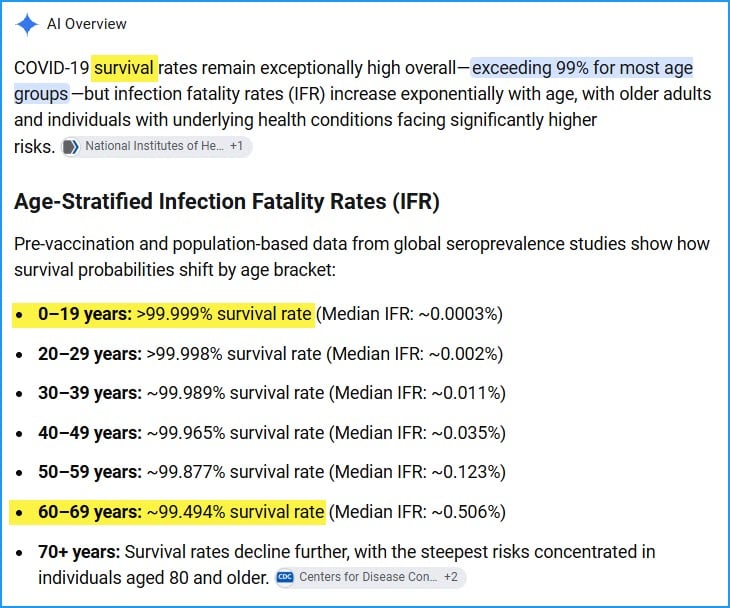
Yet, everyone, young and old alike, healthy and infirm, were treated with exactly the same draconian measures. How did we become so fearful of something with a 99.5% survival rate? With a lot of coordinated narrative control and messaging, of course. Why does the CDC still promote COVID shots to infants and children? Nobody can answer that with logic or a clear-cut risk-benefit argument.
Jeffrey’s knowledge of the entire subject is comprehensive, and his ability to tell the tale is gripping.
This was both a really great interview … and sobering.
Note:
I find AI summaries to be quite useful. So here’s an AI summary of this week’s podcast. I’ll probably start including these going forward, but rest assured I will always be crystal clear when something is written by AI. Otherwise, I write everything that carries my name.
AI Summary
The three points that carry the episode.
Point #1: The COVID response was a pre-existing plan executed for maximum harm, not an improvised public-health failure.
Jeffrey Tucker traces it to the 2005–2006 avian-flu planning under Bush: computer modelers led by Rajiv Fenikaya sold the White House on lockdowns to drive R below 1, followed by a biologic “potion,” while traditional epidemiologists like D.A. Henderson were ignored.
The resulting pandemic influenza plan was, in Tucker’s words, worse than anything in Khrushchev’s Russia and incompatible with the Bill of Rights. By late February 2020 the signals were unmistakable—the New York Times Daily podcast with Donald McNeil (“go medieval”) and Peter Daszak’s Disease X op-ed the next day.
Martenson’s framing, drawn from Toby Rogers, is that every major policy (no early treatment, ventilators and remdesivir, nursing-home seeding, school closures, the most toxic vaccines on a platform that never stopped transmission) was designed to prolong the event and maximize political effect. There has been no reckoning.
Point #2: The shots produced only harm and zero public-health benefit, and the entire institutional order pushed them anyway.
They did not stop infection or transmission, lasted at most a few months against the matching strain, and appear to have rewired immune responses. The utilitarian theory that rare harms are justified by population-level immunity therefore collapses: the product made no contribution to that immunity. Pharma, public-health agencies, media, corporate leaders, and even religious figures (Franklin Graham, a Vatican coin) championed it. Tucker calls this the greatest folly on record; Kissinger’s observation that if the plan failed they would burn everything down is, in his view, what is now happening.
Point #3: Once the totalitarian experiment failed, the system selected for the best liars, and the only path left is outside the institutions.
Tucker invokes Hayek’s chapter in The Road to Serfdom on why the worst get on top: a totalitarian plan must fail because knowledge is decentralized; when failure is obvious, the system elevates those skilled at the persistent lie and discards those who cannot. COVID was the closest thing modern America has seen to a totalitarian experiment (mandated six-foot distancing, controlled association).
The intellectual class that should have opposed it was absent, which is why Tucker founded Brownstone. Political appointments remain marionettes; real change requires parallel institutions, publications, conferences, and a population that no longer believes the commanding heights. A third of the public, he estimates, is newly aware. That awareness is the beginning of any recovery.
Chris and Jeffrey treat the COVID period as the clearest evidence that the country is not suffering from a virus but from the deliberate exercise of authoritarian power under the cover of public health. Tucker’s account begins fifteen years earlier with pandemic plans that already contained lockdowns plus a novel biologic, then moves to the February 2020 moment when the New York Times abandoned a century of “don’t panic, see your doctor” guidance and broadcast pure hysteria. The subsequent record—no early treatment, high-kill hospital protocols, suppression of off-patent drugs, and mass vaccination with a product that could not stop transmission—matches a design that maximized duration and harm. The intellectual failure that most shocked Tucker was the near-total absence of the academic and idea class that should have recognized and opposed it. Five years on, the same institutions continue to lie because, per Hayek, that is what a failed totalitarian system rewards. Political remedies inside the agencies are limited; the remaining leverage is the growing number of people who now see the corruption clearly and are building lives and institutions apart from it.
Timestamps
00:00 The Old World Is Gone
02:50 The Unanswered Questions of COVID
05:14 The Intellectual Failure of the Pandemic
07:39 Why Brownstone Institute Was Founded
21:56 When the New York Times Went Medieval
44:44 Who Was Really Calling the Shots?
53:04 Is the Public Losing Faith in Vaccines?
56:56 The CDC’s V-Safe Data Controversy
01:02:38 Why the Media Looked Away
01:05:27 Reading the Testimonies Became Unbearable
01:14:43 Hayek’s Warning About Who Rises to Power
01:18:25 Totalitarian Technocracy Thinks It Can Win
01:28:15 Can Political Reform Fix the System?
01:31:02 From Despair to Hope and Resistance
 by mike-from-jersey