


We have a Fed meeting Wednesday; this week, there was no material change in rate increase projection from the futures markets: a roughly 81% chance of a 75 basis point rate increase, with more rate increases projected to come after that. (Source)
The European Central Bank actually did raise rates 50 bp this week, for the first time in 11 years; negative rates (a gift to Europe from Technocrat Draghi, who promised to “do whatever it takes”) are now a thing of the past. Wolf Richter has a good analysis (Source), which includes a new ECB “glue gun” (Wolf’s term) that attempts to make sure the rate increase won’t cause the probably-bankrupt Italian government (debt/GDP: 151%) bond yields to end up in the stratosphere while Germany’s (debt/GDP: 69%) bond yields remains near-zero, which might end up pushing Italy out of the EU. Guess how the ECB plans to make this work? Basically its selective QE. ECB will sell all its German bonds, and hoover up Italian bonds until those pesky Italian rates drop dutifully to where the ECB wants them to be. Another win for technocracy – a “vaccine passport” for near-bankrupt EU member bond rates.
Note that the ECB will give Italy a spanking by yanking the glue-gun if it spends too much. The EU bureaucrats also plan to bribe Italy with a trickle of money if they “do the right thing”. Its all very complicated, but it ends up with the unelected EU-Technocrats deciding what’s best for the widely divergent EU member nations once more. How long will central planning continue to work? Especially with the intensely unpopular “wartime inflation” caused by the EU member nations all jumping headlong into war? A good question.
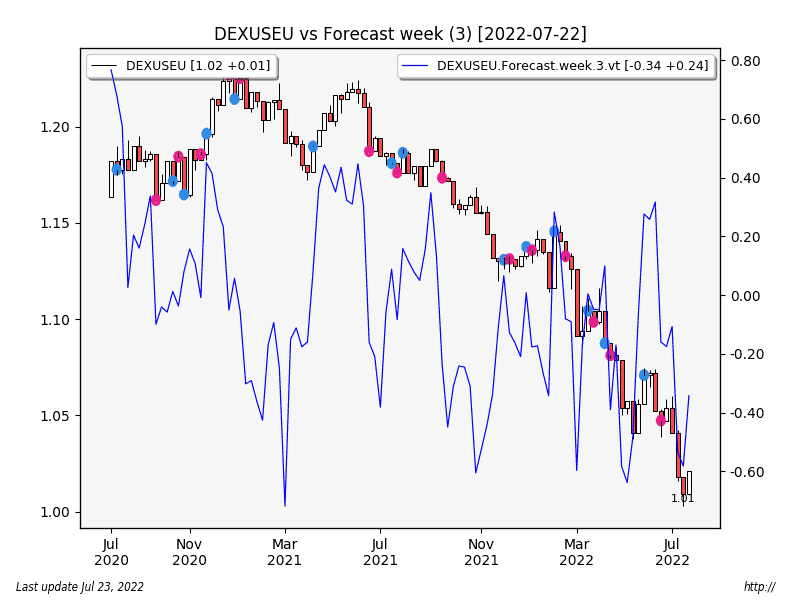
The 50 bp rate increase seemed to cause a modest Euro rally this week.
The current U.S. (and EU) inflation is comprised of a combination of “shortage inflation” along with “money-printing inflation.” When the Central Bank prints money, hands it to the banksters, who then go off and buy assets, that’s money-printing inflation. The Central Bank can easily turn this off whenever it likes – through rate increases, and quantitative tightening. Both the Fed and the ECB appear to be
 by davefairtex
