


This week, Paul and I were basically reduced to wondering how things got as ridiculous as they are.
The stock market is supposed to be forward-looking, and yet it carries on as if there were no risks at all to speak of. No war in Iran, no war with Russia, and no tail risk from AI possibly ruining everything.
Meanwhile, we discover that real people have plenty of concerns and are acting rationally.
🚨BREAKING: Chase Branches Are Reportedly Out of Money Following Bank Outageshttps://t.co/cQRfxTaWsS#Banking #MarketNews
— Frank Nez (@FNez_Blogger) November 18, 2026
We also discussed what Philip Pilkington called “Marco Monday,” which was a blatant use of government power to disrupt a major U.S. company. In this case, Marco Rubio released a report alleging that Jensen Huang’s mistress might be a Chinese spy.
Rubio took a CIA report and rewrote it in a memo “in his own more assertive terms.”
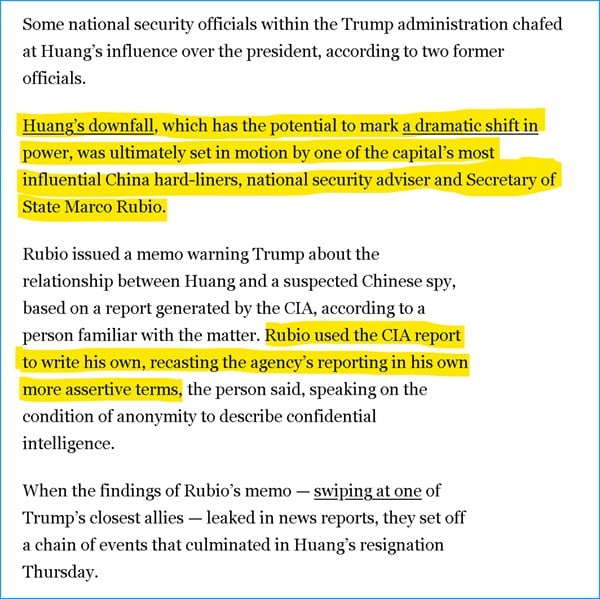
And then he made that memo public. Nvidia has tanked ever since.
The main complaint, besides “but, China!” is that Jensen was pursuing open-source AI models while the U.S. government, for obvious control-freaky reasons, prefers closed-source AI models.
So, Jensen had to go. Or something like that.
Meanwhile, commodities are signaling trouble. Gold, silver, copper, corn, wheat, oil…the list goes on and on, all have been getting absolutely hammered since the first week of September.
Is this because the U.S. government + proxies have been hammering them for political (and profit) reasons, or are they telling us that a ripper of a recession is on the way, led by a liquidity crisis?
Maybe a bit of both?
In either case, now is the time to be protecting one’s wealth with an active risk-managed strategy. The upside appears to be outweighed by the potential downside.
Tune in for more. Lots more…

AI Summary
- The post-election equity surge has reversed and NVIDIA has become the bellwether for an AI bubble that looks to be rolling over. A week after the Democratic sweep produced large one-day gains, the S&P is roughly 400 points lower, the Nasdaq about 1,600 points lower, and the Dow down around 3,000. NVIDIA, which peaked near $5 trillion in early October, is down about 37 percent and sold off even after strong earnings. Chris and Paul treat the stock as the single most important name in the indexes because it sits at the center of the CapEx and circular-financing loop. Retail buyers stepped in on the drop; both men see that as late-cycle behavior rather than a durable floor.
- Government intervention has crossed from regulation into direct ownership and selective targeting of domestic companies, and the closed-versus-open AI fight is the proximate cause. Under the prior administration the U.S. took an equity stake in Intel and sought a cut of certain chip sales. The more recent episode is the classified memo, attributed to Marco Rubio, that portrayed Jensen Huang as close to a suspected Chinese spy, followed by his exit and the installation of unusual national-security oversight at NVIDIA. Philip Pilkington (referenced from the prior interview) called the day “Marco Monday” and read it as the top of the AI bubble. The underlying policy preference is for closed models (Anthropic, OpenAI) that can be licensed and controlled; Huang had favored open models and acquired Hugging Face. Open models (DeepSeek and others) are already cheaper and faster, so the attempt to lock the West onto the closed track is, in Chris’s phrasing, “fighting gravity.” The same period revealed NVIDIA’s own circular financing: commitments and guarantees jumped from $184 billion to $530 billion in one quarter, with the company effectively funding or backstopping customers who then buy its GPUs and, if utilization falls short, selling the unused capacity back to NVIDIA.
- Markets are no longer delivering clean signals, cost-push inflation is already visible, and the practical response remains adaptive positioning rather than passive exposure. Copper, energy, and grains have been driven lower despite physical constraints and SPR draws; pending home sales remain at record lows. A flange manufacturer has already raised prices because steel is booked through 2027–28. Paul notes that Bank of America fund-manager surveys have shifted from “spend on CapEx” to “pull it back.” Technical structure on the S&P shows a multi-month topping process rather than a clean break; seasonality into year-end may still produce bounces, but neither man expects new highs. At the same time, regional banks are seeing elevated cash withdrawals, payment systems have suffered repeated outages, and the software stack that AI tools can now probe is widely described as unpatchable. Paul’s counsel is unchanged in substance: harvest gains when the weight of the information warrants it, hold cash and food reserves, stay under deposit-insurance limits or in Treasury vehicles, and treat passive index exposure as hope rather than a strategy. Historical analogs (railroads, 2000 tech) show that the builders of the infrastructure often do not capture the long-term gains; the capital is destroyed and later reused by others.
Chris and Paul record a week after the election-driven spike and treat the subsequent reversal, led by NVIDIA, as the clearest sign that the AI-financing loop is under political and economic pressure. The same government that has begun taking ownership stakes and directing chip sales is now intervening inside a domestic champion to favor closed models that face cheaper open-source competition and that cannot replace NVIDIA’s hardware-plus-circular-credit role. Underneath, physical indicators (steel availability, housing transactions, energy inventories) continue to diverge from the prices that algorithms and narrative can still push around. Their close is the same practical one: the signals are noisier and more actively managed than in prior cycles, the easy trades are the ones being sold into strength, and the households that will navigate the next stretch better are those already reducing leverage, holding real reserves, and remaining willing to change position as the data, not the pitch or the policy preference, changes.
Timestamps
00:00 The AI Trading Landscape and Market Dynamics
03:55 Nvidia: The Bellwether of AI Stocks
05:46 Political Intrigue and Corporate Espionage
10:15 The Battle of AI Models: Open vs Closed
11:59 Circular Financing and Market Implications
17:06 The Risks of AI Implementation and Market Volatility
21:33 Navigating the Bubble: Strategies for Investors
23:44 Commodity Market Turmoil
25:40 Economic Indicators and Farmer Struggles
27:53 Political Implications of Commodity Prices
30:18 Liquidity and Market Dynamics
32:58 Deflationary Signals and Economic Concerns
35:15 The Role of the Dollar in Global Markets
38:00 Corporate Earnings and Market Valuation
40:55 Global Liquidity and Economic Stability
42:43 Investment Strategies in Uncertain Times
49:57 Consumer Resilience Amid Economic Challenges
52:36 Liquidity and Market Dynamics
54:37 Housing Market and Economic Indicators
57:10 Market Signals and Investor Behavior
01:00:54 Market Structures and AI Influence
01:08:41 Potential External Threats and Market Reactions
FINANCIAL DISCLAIMER:
The information contained in this video and the resources available for download through our affiliated website are not intended as, and shall not be understood or construed as financial advice, nor should it be interpreted as a solicitation to sell or an offer to sell investment advisory services. No person who currently works for or contracts with Peak Prosperity or Peak Financial Investing is an attorney or accountant, nor are we holding ourselves out to be, and the information contained in the video and on the website is not a substitute for legal or tax advice from a professional who is aware of the facts and circumstances of your individual situation. While Peak Financial Investing is a registered investment advisor, please note that this podcast is not intended to be investment advice.
All information has been obtained from sources believed to be reliable, but its accuracy is not guaranteed. There is no representation or warranty as to the current accuracy, reliability, or completeness of, nor liability for, decisions based on such information, and it should not be relied on as such. We have done our best to ensure that the information provided is accurate and provides what we feel is valuable information. The views expressed are subject to change based on market and other conditions.
No guests or clients appearing on the podcast receive any form of compensation for their appearance and obtain no other benefit from either Peak Prosperity or Peak Financial Investing.
All investing involves risks, including the possible loss of capital. Asset allocation and diversification do not ensure a profit or protect against loss. Please note that outperformance does not necessarily represent positive total returns for a period. There is no assurance that any investment strategy will be successful. All investments carry a certain degree of risk. Dividends are not guaranteed, and a company’s future ability to pay dividends may be limited.
Additional important disclosures for Peak Financial Investing may be found in our Form ADV Part 2A, which can be found at https://adviserinfo.sec.gov/firm/summary/319672.


 by cmartenson