


This week Paul and I discussed the importance of having so many gray hairs on our heads. We were there and paying attention to markets during the prior two bubble bursts. We know the warning signs and the portfolio damage that accompanies their bursting.
Today, we’re supposed to believe that AI spending and data centers are the path to future prosperity.
But it wasn’t that long ago the people mattered, and the stock market took note of things like auto and home sales.
On that front, pending home sales have hit a record low.
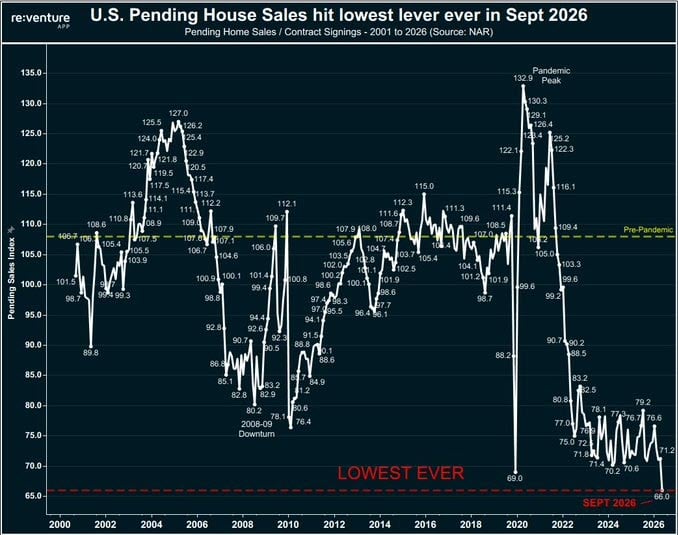
Maybe AI is going to be so awesome that real estate no longer matters?
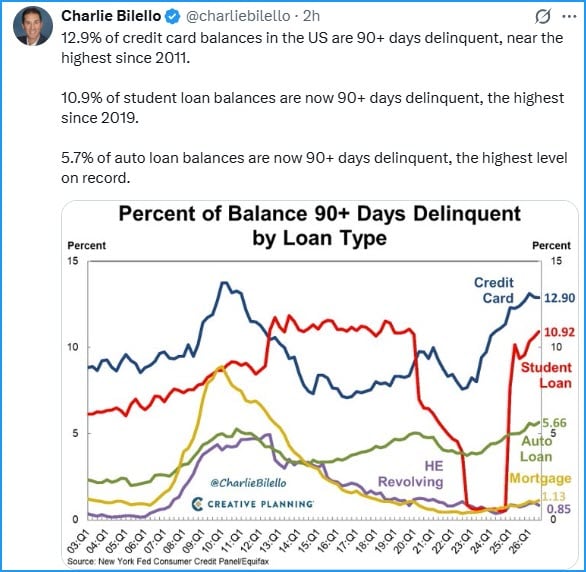
Also, 90+ day delinquencies on auto loans have hit a new record:
Further, oil seems not to matter anymore either. The price has gone steadily down since the middle of October despite a huge increase in attacks on ships trying to shuttle through the Strait of Hormuz using the U.S.-preferred Southern Omani route.
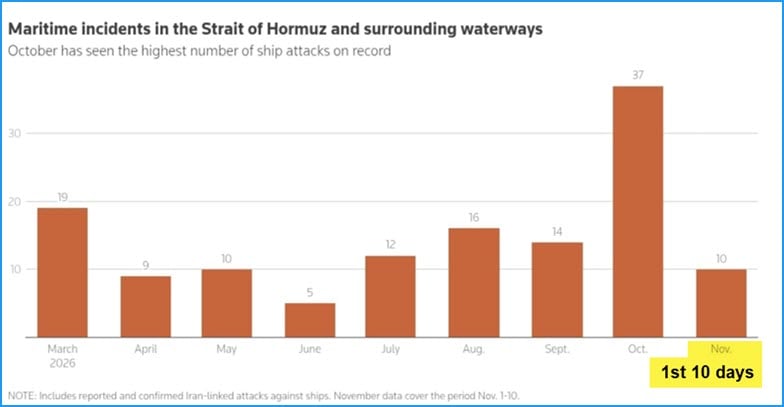
Every single day ships are attacked, yet the claims are being made that “more oil than ever” is flowing out of the Persian Gulf. These two pieces of information are completely at odds with each other and for now I will continue to believe my lying eyes.
In the past 24 hours at least 6 ships hit Iran’s Naval Mines and many others were hit with anti-ship missiles in the HormuzThe Hormuz is closed and Iran is not giving it up pic.twitter.com/pFu0bY08KP
— Ryan Rozbiani (@RyanRozbiani) November 11, 2026
Tune in for the rest!

Note:
I find AI summaries to be quite useful. So here’s an AI summary of this week’s podcast. I’ll probably start including these going forward, but rest assured I will always be crystal clear when something is written by AI. Otherwise, I write everything that carries my name.
AI Summary:
- Aggressive selling of AI and private equity is a late-cycle exit-liquidity signal. Chris recounts being pushed into WorldCom in 2000 and later realizing he was the buyer the insiders needed. Paul is hearing the same pattern now: private-equity minimums dropping from a million dollars to $25,000, advisors belittling clients who want to reduce risk, and heavy promotion of anything tied to the “new age.” Anthropic’s IPO is slated for mid-November at a still-enormous valuation, SpaceX has already come public, and original holders are seeking liquidity. Paul uses the Pfizer chart from 1995–2000 as the template: the easiest, best-looking story is usually the moment of highest risk for the new buyer. Liquidity remains abundant—M2 is up, AI-related lending is still large—but data-center projects are already being delayed and the CapEx wave is past its peak intensity. Pending home sales hit the lowest level on record in September, removing one other potential source of broad demand.
- Oil is trading as if the Gulf is quiet while ships are being hit daily, and cost-push inflation is already visible in real production. Nothing material has been resolved, yet oil is falling. Chris and Paul treat the price action as narrative and algorithmic rather than a reflection of physical conditions. At the same time, the October CPI showed food, electricity, and fuel oil rising faster than the headline, and a flange manufacturer in Illinois has announced price increases because domestic and offshore steel is largely booked through 2027–28, with European gas storage too low to support normal production. These are supply shocks, not demand surges. Chris expects more of the same; Paul is more concerned that inflation will squeeze corporate margins the way it did in the mid-1970s than that a deep recession is already under way.
- AI is accelerating through recursive self-improvement and exposing a fragile digital infrastructure. Anthropic’s models are reportedly advancing on tasks at roughly twice the prior rate because the systems are now aiding their own research. That speed creates both economic concentration risk (the CapEx and the narrative that currently support liquidity) and practical security risk: legacy software stacks are full of holes, recent tools have already demonstrated the ability to find them, and the same capabilities are being used for intrusion. Paul recommends holding three months of cash and three months of food precisely because a short disruption to banking or payments is no longer a remote scenario. Neither man is calling a definitive market top, but both treat the combination of easy stories, suppressed oil, visible cost-push, and accelerating AI as a reason to stay adaptive rather than fully passive.
Chris and Paul open on the familiar late-cycle feeling: the pitch is loudest just as the insiders begin to exit, and the physical indicators (Gulf shipping, steel availability, housing transactions) are diverging from the prices and the narrative. Liquidity can still lift everything in sympathy, but the sources of that liquidity are narrowing to AI-related spending and continued fiscal deficits. The practical close is the same one they have been making: the weight of the information is rising, the easy trades are the ones being sold, and the people who will navigate the next stretch better are those already reducing leverage, holding real reserves of cash and food, and remaining willing to change position as the data, not the pitch, changes.
Timestamps
00:00 The Opportunities Wall Street Isn’t Selling
02:08 When Investors Become Exit Liquidity
05:56 Dot-Com Lessons and Today’s AI Sales Pitch
11:25 Where Is the Next Wave of Liquidity Coming From?
17:20 Inflation, Steel Shortages and the Coming Cost Squeeze
27:06 Consumer Debt Delinquencies Tell a Different Story
31:56 Falling Oil Prices Amid Escalating Gulf Attacks
37:56 Russian Refinery Strikes and the Global Diesel Crunch
42:47 The AI Spending Bubble and What Happens When It Ends
48:02 AI Is Exposing a Cybersecurity Nightmare
52:22 Preparing for a Digital-System Breakdown
55:54 AI’s Promise, Medical Breakthroughs and the Rise of Robotics
57:41 Peak Complacency and Navigating the Unknown
FINANCIAL DISCLAIMER:
The information contained in this video and the resources available for download through our affiliated website are not intended as, and shall not be understood or construed as financial advice, nor should it be interpreted as a solicitation to sell or an offer to sell investment advisory services. No person who currently works for or contracts with Peak Prosperity or Peak Financial Investing is an attorney or accountant, nor are we holding ourselves out to be, and the information contained in the video and on the website is not a substitute for legal or tax advice from a professional who is aware of the facts and circumstances of your individual situation. While Peak Financial Investing is a registered investment advisor, please note that this podcast is not intended to be investment advice.
All information has been obtained from sources believed to be reliable, but its accuracy is not guaranteed. There is no representation or warranty as to the current accuracy, reliability, or completeness of, nor liability for, decisions based on such information, and it should not be relied on as such. We have done our best to ensure that the information provided is accurate and provides what we feel is valuable information. The views expressed are subject to change based on market and other conditions.
No guests or clients appearing on the podcast receive any form of compensation for their appearance and obtain no other benefit from either Peak Prosperity or Peak Financial Investing.
All investing involves risks, including the possible loss of capital. Asset allocation and diversification do not ensure a profit or protect against loss. Please note that outperformance does not necessarily represent positive total returns for a period. There is no assurance that any investment strategy will be successful. All investments carry a certain degree of risk. Dividends are not guaranteed, and a company’s future ability to pay dividends may be limited.
Additional important disclosures for Peak Financial Investing may be found in our Form ADV Part 2A, which can be found at https://adviserinfo.sec.gov/firm/summary/319672.

 by cmartenson