


At the time of this recording, it was 13 days to the midterm elections. Does that help explain why the “markets” have been so calm lately? Bond yields have moderated, stocks are hanging in there, and oil cannot stay above $100/bbl in the U.S. You know what? It wouldn’t be the first time I’ve observed these sorts of pre-election oddities.
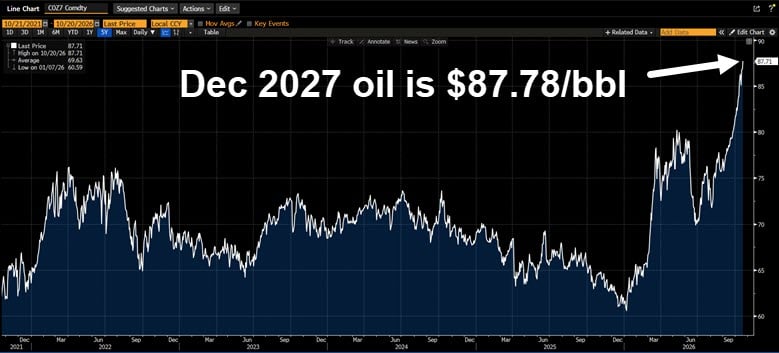
But that strikes me as crazy, because things are still exploding in Saudi Arabia and in the Strait of Hormuz, and oil futures a year out are rising sharply, indicating that the perception of future geopolitical calm and abundant oil is rapidly fading away.
That’s a pretty serious spike:
The above chart might be explained by this next one that shows falling crude oil supplies at refineries (global):
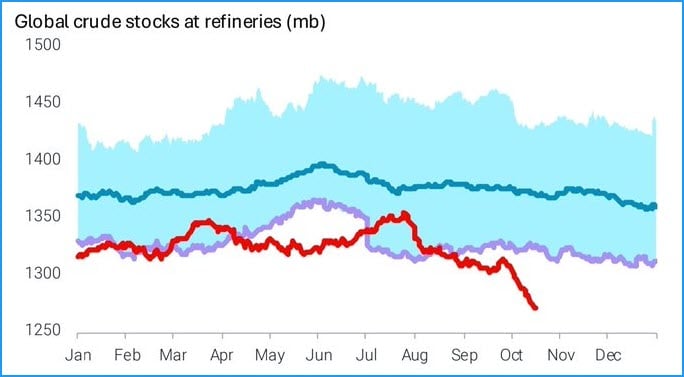
The lower stockpiles go, the greater the chance of a sharp upward price spike.
Meanwhile, the housing market is falling apart with pending home sales collapsing to levels not seen since before 2001 (which is as far back as this chart goes).
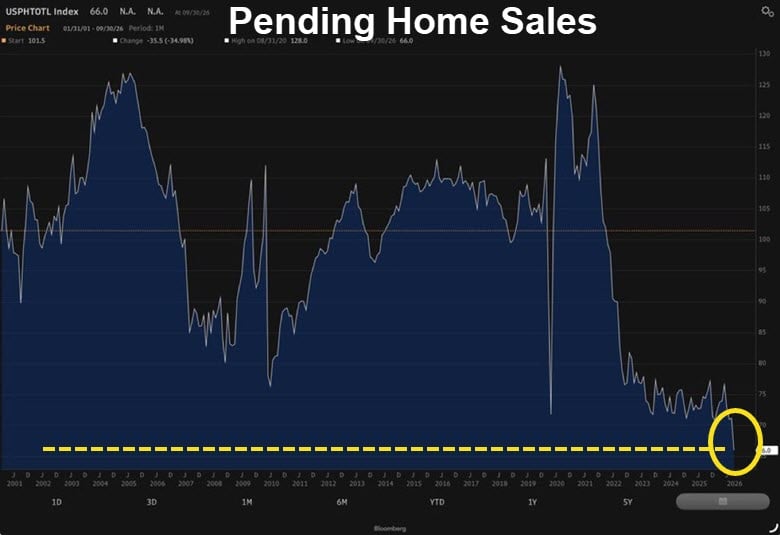
Pending home sales are lower than at any point during the Great Financial Crisis, or even during the spike-bottom of COVID.
Another oddity that Paul Kiker and I discussed is the sharp break between the amount of gold held in gold ETFs such as GLD (left-hand axis), and the price of gold per ounce (right-hand axis).
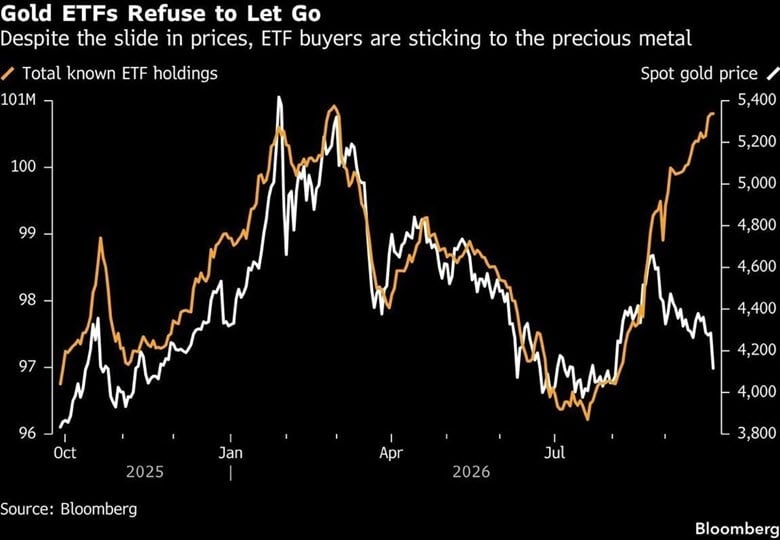
Whenever such serious departures happen from a long-standing correlation, it usually pays to pay close attention.
To hear the rest…tune in!
Note:
I find AI summaries to be quite useful. So here’s an AI summary of this week’s podcast. I’ll probably start including these going forward, but rest assured I will always be crystal clear when something is written by AI. Otherwise, I write everything that carries my name.
AI Summary:
Point #1: Pre-election calm is being enforced by narrative and intervention while physical oil stocks keep falling. Thirteen days from the midterms, markets are in a holding pattern Chris has seen before other big elections. Oil was clubbed from about $101 to under $96 on a single El Arabia report of a US-Iran deal; Iran and the actual negotiators denied it within minutes, yet the price only recovered a couple of dollars. Open interest is dropping as legitimate traders step back. Above-ground reserves are declining week after week, Saudi-Houthi damage is under a news blackout, and satellite tracking does not match the official Strait of Hormuz flow numbers. The short-term price is being managed; the inventory trend is not.
Point #2: Longer-dated oil futures have broken higher, and that is the signal energy companies and inflation are keying off. December 2027 oil has risen from roughly $65–70 to about $87 since June—a roughly 35 percent increase in the year-ahead price. Paul notes that the buyers of those contracts are the most informed participants, not retail, and that the move has cleared multi-year resistance. China is returning to the import market, diesel is tight enough that the US is taking Russian cargoes despite being a major exporter, and global crude stocks at refineries are falling below the five-year range. That last chart is decisive: inventories are drawing, so current Gulf-plus-elsewhere supply is not meeting demand.
Point #3: Housing and gold are already showing the stress that a suppressed oil price cannot hide. Pending home sales are at the lowest level in the data series; nationally there are more sellers than buyers, September saw a record share of contracts falling through on financing, and banks have tightened standards. Commercial office space continues to clear at pennies on the dollar. At the same time, US retail gold buying has risen as the price falls (the opposite of the usual American pattern), and Ray Dalio’s family office is reported at roughly 87 percent of its US-listed book in GLD plus IAU. Paul’s read is that cost-push from energy leaves the Fed able to defend bonds or the dollar, but not both, and that an equity crack is the only near-term force that would reliably pull yields lower.
Chris and Paul treat the current tape as an election-timed holding pattern rather than a genuine equilibrium. Oil is the clearest example: fake or unconfirmed headlines produce sharp sell-offs that do not fully reverse, while the futures curve out a year has steepened and physical stocks at refineries continue to draw. Energy equities have ground higher through the noise and remain underinvested relative to the long-term supply picture. Under the surface, the real economy is already adjusting—college graduates struggle to find jobs, residential transactions are freezing on financing, and commercial real estate is clearing at distressed prices—while large allocators such as Dalio’s family office are moving heavily into gold. Their practical close is unchanged: the suppression can continue for a while, but the inventory, futures, and housing data say the path of least resistance for energy and inflation is higher, so stay liquid, avoid complacency, and let the weight of the information, not the daily narrative, set the position.

Timestamps
00:00 Democracy, Freedom, and the Official Narrative
00:33 Markets in a Holding Pattern Before the Midterms
02:02 Investors Caught Between Fear and FOMO
05:10 The Oil Market Gets Clubbed by a Rumor
07:18 Controlling the Narrative Instead of Telling the Truth
10:37 Oil Futures Signal a Much More Expensive 2027
14:52 Why Energy Could Outshine the AI Trade
19:21 Inflation Statistics Versus the Bills People Actually Pay
22:01 The Second Inflation Wave and Europe’s Energy Crisis
36:13 Gold ETF Buying Surges While Prices Fall
43:34 Housing Stress Builds as Buyers Walk Away
51:16 Prepare for the Worst While Markets Pretend All Is Well
53:11 The Midterm Election Is Over. Then What?
FINANCIAL DISCLAIMER:
The information contained in this video and the resources available for download through our affiliated website are not intended as, and shall not be understood or construed as financial advice, nor should it be interpreted as a solicitation to sell or an offer to sell investment advisory services. No person who currently works for or contracts with Peak Prosperity or Peak Financial Investing is an attorney or accountant, nor are we holding ourselves out to be, and the information contained in the video and on the website is not a substitute for legal or tax advice from a professional who is aware of the facts and circumstances of your individual situation. While Peak Financial Investing is a registered investment advisor, please note that this podcast is not intended to be investment advice.
All information has been obtained from sources believed to be reliable, but its accuracy is not guaranteed. There is no representation or warranty as to the current accuracy, reliability, or completeness of, nor liability for, decisions based on such information, and it should not be relied on as such. We have done our best to ensure that the information provided is accurate and provides what we feel is valuable information. The views expressed are subject to change based on market and other conditions.
No guests or clients appearing on the podcast receive any form of compensation for their appearance and obtain no other benefit from either Peak Prosperity or Peak Financial Investing.
All investing involves risks, including the possible loss of capital. Asset allocation and diversification do not ensure a profit or protect against loss. Please note that outperformance does not necessarily represent positive total returns for a period. There is no assurance that any investment strategy will be successful. All investments carry a certain degree of risk. Dividends are not guaranteed, and a company’s future ability to pay dividends may be limited.
Additional important disclosures for Peak Financial Investing may be found in our Form ADV Part 2A, which can be found at https://adviserinfo.sec.gov/firm/summary/319672.

 by davidmolson