


At the Limitless conference in Phoenix last August, I was on a panel discussing what the Fed might do and where interest rates were headed. Jeff Snyder and Brent Johnson, who made up the rest of the panel, disagreed with my predictions that (a) interest rates were headed higher and (b) the Fed was going to raise rates.
Both of those things have come to pass since the conference.
Here’s how I knew that.
My model for the Fed is simple: they pretend they are in control, but they’re actually at the mercy of the bond market. To ‘predict’ what the Fed is going to do – raise or lower rates – all I have to do is peek at the 2-year bond yield and observe if it’s higher or lower than the Fed interest rate.
If the two-year is higher, then the Fed is going to raise rates. If it’s lower, then the Fed will drop rates. It’s been this way for decades, and it’s not much of a secret.
The chart below shows the last 25 years of history for the Fed Funds rate (black) and the 2-year interest rate (green). If you look carefully, you’ll see that the 2-year rate turns upward every time before the Fed (grudgingly) follows suit.
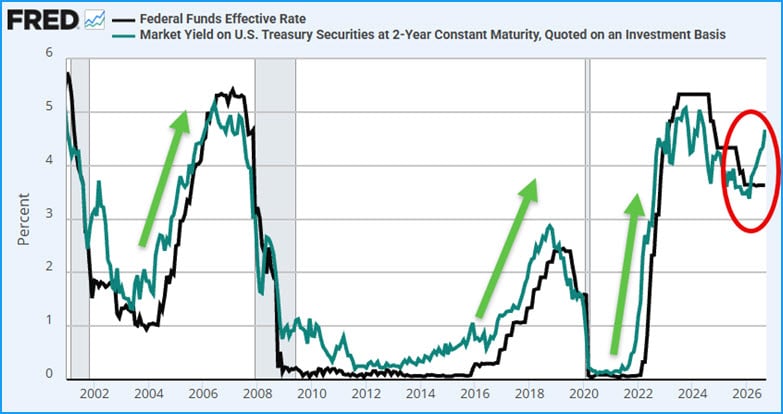
Also note, circled in red, that since early 2026 the 2-year rate has been screaming higher than the Fed interest rate and that huge gap was creating pressure on the Fed to raise rates, which they just did.
My prediction that interest rates would be heading higher was based on my view that oil was headed higher. At the time of the panel, the 10-year rate was 4.74. Today it is 4.94 and has even recently reached the 5% level (and will do so again as oil keeps heading higher).
About that observation…bonds hate inflation. In the 1970’s high inflationary periods, bonds were not-so-affectionately called “certificates of confiscation.”
Inflation is mainly driven by excessive government deficits. We had high deficits in the 1970s, and we have even higher
 by jstokes
