


It’s a tale of two economic worlds. On the one hand, factory expansion and soaring stock earnings say everything is robust. On the other hand, a big chunk of that expansion (about 50%) is due to AI expenditures and buildouts. Which means those are probably more like a one-time burst of activity than a durable activity likely to be repeated every year hereafter.
But man! Take a look at those earnings!
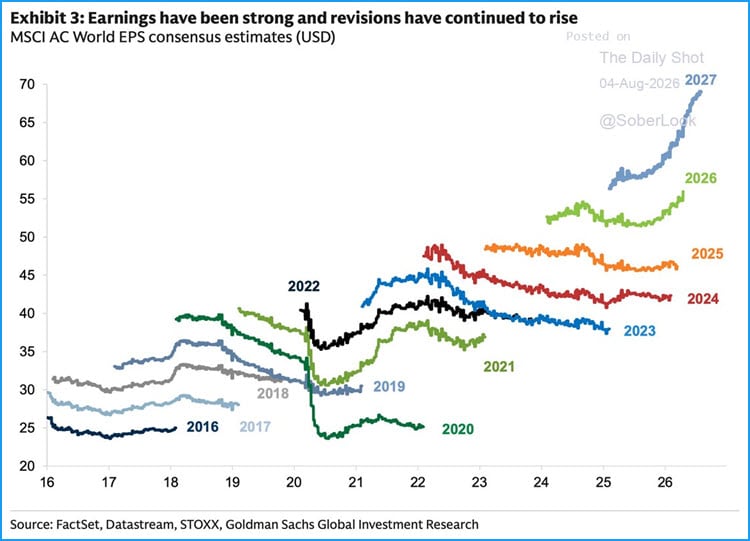
(Source – @soberlook on X)
The problem with earnings is that historically, they are the most ‘mean-reverting’ indicator of them all. Which makes sense: record profits tend to attract competition, which drives profits down to a sustainable level.
Nonetheless, at the time of this recording, equities had powered to all-time new record highs in the Dow and the S&P 500 (The Nasdaq fell just short). It seems we have reached a permanently high plateau of prosperity!
Also adding to our cautious outlook is that late-cycle speculation extremes are popping up. Such as record call option buying.
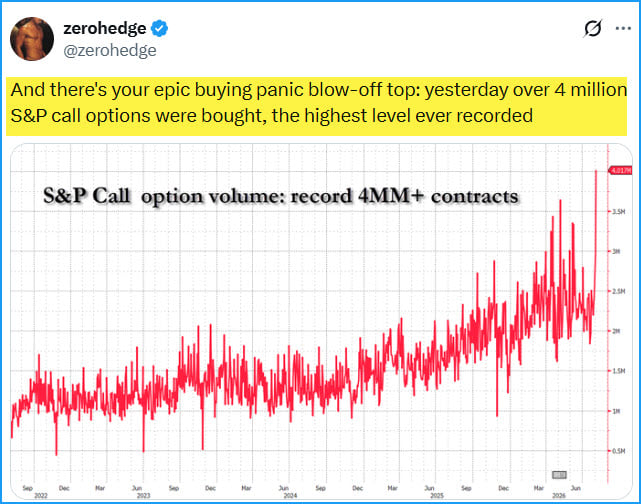
But on top of record stock prices, we have to also call out the record levels of debt the US government is piling up. With total government debt now at $39.7 trillion, and with July’s deficit alone totaling an eye-watering $382 billion. For reference only, that’s $4.5 trillion annualized. However, that’s not the right way to look at it because tax months are always lower; I’m just putting it into perspective.
What this means is that there are going to be more and larger issuances of government Treasury debt. Which means more inflation is in the cards.
With Europe running into its own problems (we call out France specifically) and Japan finding itself in a bit of a monetary pickle requiring the sale of Treasury paper, questions emerge about who is going to soak up all this Treasury paper.
The answer, in the form of rising interest rates, is “not at these prices.”
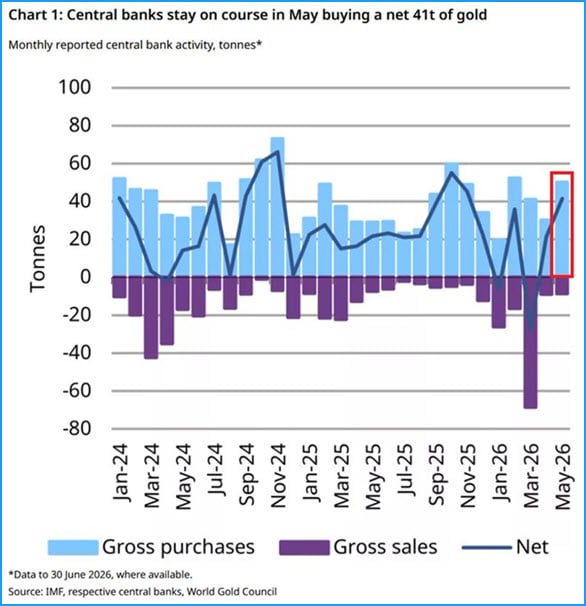
We also spent a good chunk on time on gold, observing that if it’s good enough for central banks, then it’s probably good enough for us too:
We also discussed (mostly AI-generated):
- AI spending is creating a new competition for capital. Hyperscalers are expected to invest trillions into AI infrastructure, potentially requiring enormous borrowing. This could put them in competition with the U.S. government, which also needs vast amounts of capital to fund ongoing deficits.
- Social Security funding pressures are beginning to emerge. With Social Security cash surpluses having turned into serious deficits, we expect Congress to suddenly become interested in “reforming” SocialSecurity probably by raising payroll tax rates, enforcing later retirement ages, and/or reducing benefits for future retirees.
- China continues moving toward gold accumulation and reduced reliance on the dollar system. We discussed China’s ongoing gold purchases, encouragement of domestic gold ownership, and its efforts to make the yuan more convertible through gold-backed mechanisms.
- Gold and silver may be approaching an important turning point. Despite weak sentiment and recent declines, Paul noted that fundamentals remain supportive due to central-bank buying, inflation concerns, currency instability, and rising demand for hard assets.
- Mining stocks have been punished despite strong fundamentals. Our discussion highlighted the contrast between strong miner cash flows and poor market performance for those companies, suggesting that investor narratives may be overshadowing underlying value.
- Energy markets are being distorted by intervention and geopolitics. Oil prices have been repeatedly pushed lower by optimistic headlines and policy messaging despite ongoing supply risks. But the price is too low, as noted by declining inventories. When the price is right, inventories remain stable.
- The Strait of Hormuz crisis remains a major wildcard. Is the Strait open or closed? Will the US have a say in it or have Oman and Iran cut it out of the picture? If that’s happened, how will the US respond?
- Markets are increasingly driven by algorithms, headlines, and intervention rather than fundamentals. Rapid price swings based on government comments, Trump Tweets, and policy signals have made markets harder to interpret and increased the risk of sudden reversals.
Final takeaway: The economy is supported by extraordinary and unusual forces: AI spending, government deficits, financial intervention, and extreme investor optimism. While the near-term outlook remains strong, unresolved debt, inflation, energy vulnerabilities, and speculative excesses could create significant risks to the downside when the current cycle eventually turns.

Timestamps
00:00 Inflation Is Higher Than Advertised
00:35 Record Earnings Meet A Weak Economy
05:48 Speculative Fever Hits The Markets
08:34 Inflation And The Fed’s Impossible Choice
16:08 America’s $40 Trillion Debt Problem
19:04 AI And The Race For Capital
23:41 Social Security’s Hidden Cash Drain
31:00 China Holds The Currency Fuse
35:46 Japan’s Currency Intervention Backfires
55:13 Gold And Silver Finally Turn
01:04:05 The Treasure Buried Beneath The Narrative
01:08:03 Oil Gets Clubbed While Supplies Vanish
FINANCIAL DISCLAIMER:
The information contained in this video and the resources available for download through our affiliated website are not intended as and shall not be understood or construed as financial advice, nor should be interpreted as a solicitation to sell or offer to sell investment advisory services. No person who currently works for or contracts with Peak Prosperity or Peak Financial Investing is an attorney or accountant, nor are we holding ourselves out to be, and the information contained in the video and on the website is not a substitute for legal or tax advice from a professional who is aware of the facts and circumstances of your individual situation. While Peak Financial Investing is a registered investment advisor, please note that this podcast is not intended to be investment advice.
All information has been obtained from sources believed to be reliable, but its accuracy is not guaranteed. There is no representation or warranty as to the current accuracy, reliability or completeness of, nor liability for, decisions based on such information and it should not be relied on as such. We have done our best to ensure that the information provided is accurate and provides what we feel is valuable information. The views expressed are subject to change based on market and other conditions.<
No guests or clients appearing on the podcast receive any form of compensation for their appearance and obtained no other benefit from either Peak Prosperity or Peak Financial Investing.
All investing involves risks including the possible loss of capital. Asset allocation and diversification does not ensure a profit or protect against loss. Please note that out- performance does not necessarily represent positive total returns for a period. There is no assurance that any investment strategy will be successful. All investments carry a certain degree of risk. Dividends are not guaranteed, and a company’s future ability to pay dividends may be limited.
Additional important disclosures for Peak Financial Investing may be found in our Form ADV Part 2A, which can be found at https://adviserinfo.sec.gov/firm/summary/319672.

 by irishprince