


One poignant moment during my recent interview with Tucker Carlson was his coming to the realization that markets aren’t what he thought they were. Instead of being transparent places where willing buyers and sellers engage in price discovery, they are instead “fake.” His word, not mine. Well, also mine, but I didn’t supply it to him.
And indeed, they are. Maybe not 100% of the time, but often enough to dismantle the idea that they are accurately telegraphing useful price signals upon which we all depend.
I told him about the overnight shenanigans that have long plagued the silver market had begun to show up in oil too. The overnight markets typically have very low volume. This is true for all commodities. So it’s always a bit of a red flag when there’s suddenly a huge spike of selling compressed into a small window of time.
To provide a very recent example, we’re going to take a close look at the early morning hours of 7/24/26 (this morning in terms of this report).
Early in the morning, at precisely 4:29 am, a whopping 5,120 oil contracts representing 5,120,000 barrels of oil ‘traded’ during a single one-minute ‘tick.’ The prior average number of contracts trading per 1-min tick was ~150 contracts.
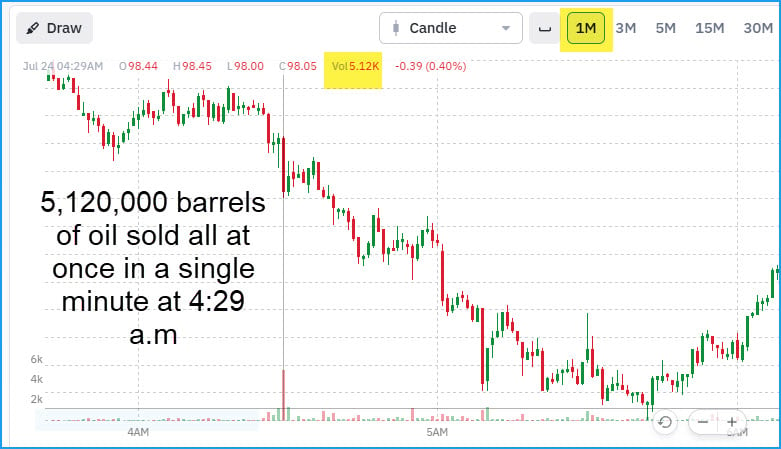
I put ‘traded’ in quote marks because this isn’t how legitimate price discovery happens. Trading implies a legitimately functioning market. Instead, this is how price setting happens. In this instance, a spike of volume 34x the prior average suddenly hit the tape.
If you were a legitimate producer wishing to hedge your future production by selling oil futures, you wouldn’t suddenly dump them all into a single one-minute window because, frankly, that would be retarded. You’d get the worst possible pricing result out of that.
What is the point of someone selling so much paper oil in a minute-long dump? To lower the price, obviously. Such a power move is designed not to discover a true market-clearing price, but to smash through that point of equilibrium and set a new, lower price.
Note in the chart above that once that burst of activity had taken place at 4:29 am, the trend was set, and much larger downward jogs could be accomplished on much lower volume.
That’s because the other market participants, algos and humans alike, know as well as I do how to interpret that massive paper dump. Everyone, carbon or silicon-based, either steps out of the way or piles on by doing their own selling. The manipulation consists of a good, swift kick down the stairs, which gets the process started. The question is, who is behind that? Who is doing that kicking?
The way I suspect this happens is that a trading house or firm, possibly with government backing (meaning funding and a waiver of wash trading rules), trades with itself (and/or a conspiring firm) by both selling contracts and snapping them up at lower and lower prices on the other side.
This way, they are not at risk of having to settle up with real oil in the future. I don’t know for certain this is happening, but it’s how I would do it if I were them.
The Problem With Manipulating the Oil Price
I completely understand the political pressures and egos involved that could make compelling cases for smashing the price of oil lower. But they really should not be doing it, nonetheless.
The most powerful and simple of economic charts is the “P-Q” chart. It shows the relationship between price, supply, and demand to discover the true market-clearing price for an item.
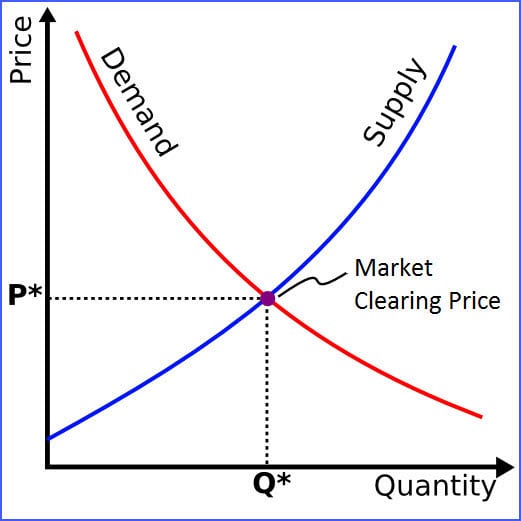
If you alter that relationship by artificially holding the price too low, the effect will be to cause demand to be too high relative to supply. In the case of oil, if the price were being held too low relative to new supply, we’d predict that we’d see falling inventories. And that is exactly what we see:
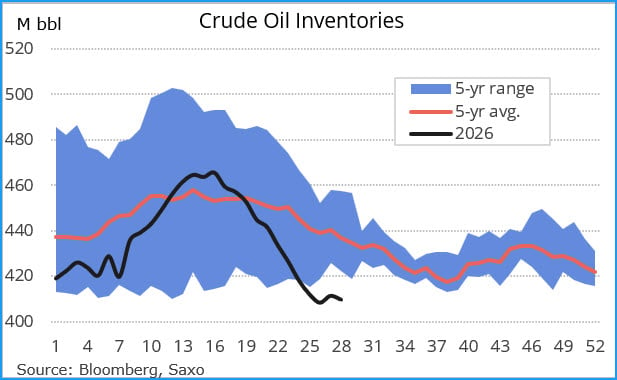
The x-axis is in weeks of the year, and ever since the start of the Iran War, US inventories of crude oil have been plunging.
That’s also true for gasoline and ‘distillate’ which consists of diesel, heating oil, and jet fuel.
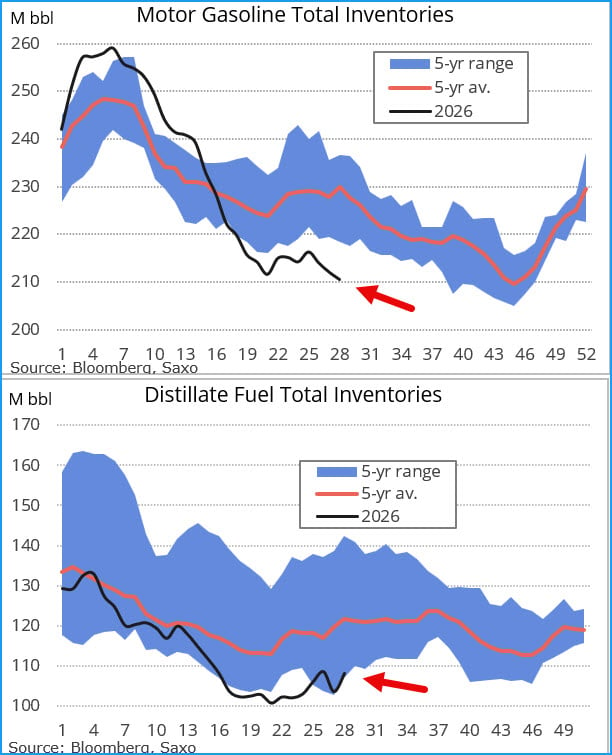
My conclusion is that someday in the not-too-distant future, inventory panic will set in, prices will explode higher, and that will cause a severe economic shock. At that point, we’ll all be sorry that the oil price manipulators did what they did. But they’ll almost certainly have moved on to creating some other set of problems by then.
The only solution is completely open and transparent markets, where we can see who is doing the trading and where speculative limits are set so that those participants cannot ever be more than a minor percentage of the overall activity for vital commodities such as crude.
 by sand_puppy