


We’re in the fog of war, and the level of propaganda and narrative structuring around the “markets” has reached a fever pitch. And so have equity prices around the world.
Who knew that a war in the Middle East that has led to the largest energy shock in human history would be so bullish?
Here’s Yahoo Finance on May 6th with a couple of narrative pitches to “explain” the explosive, historically unprecedented rise in stock prices:
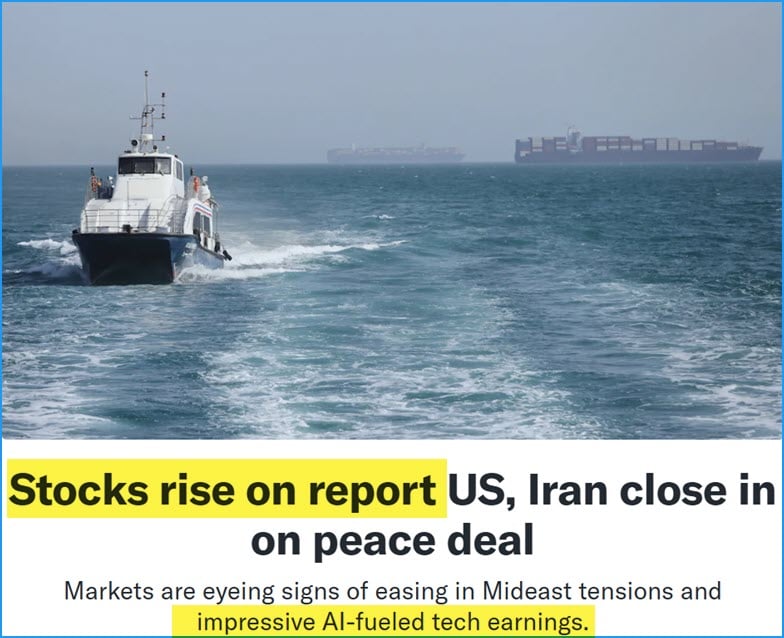
First, the “report” was another Axios headline, citing unnamed sources, pitching the ridiculous notion that Iran had essentially agreed to every US wish-list condition in a one-page MOU (another ridiculous notion for such a complicated affair).Iran immediately denied having agreed to any such thing, but the “markets” didn’t care; they had the bullish headline they needed to support a bullish narrative.
But, more subtly, why would peace be so bullish when war itself has been so bullish?
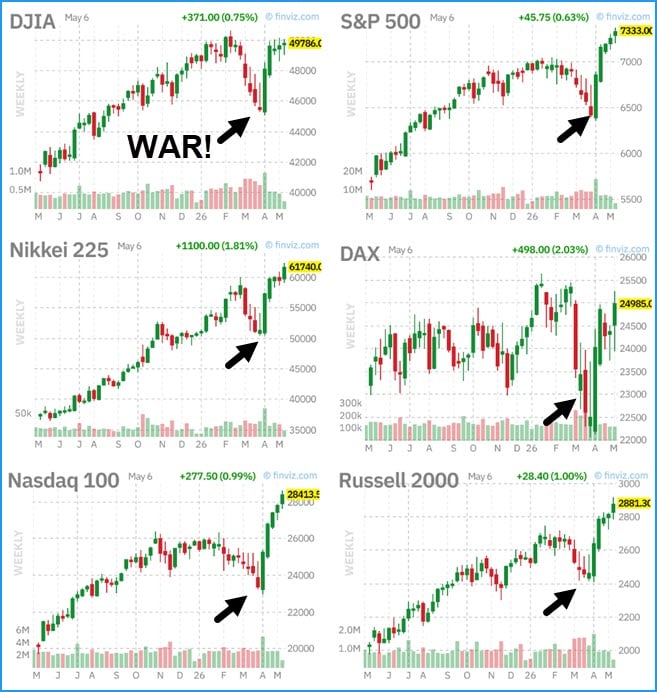
Wouldn’t it stand to reason that if war is bullish, then peace is not? Shouldn’t it be one or the other if either was the cause?
Second, Paul Kiker and I discussed those “impressive AI-fueled tech earnings,” many of which are the result of circular cash flows, such as when Google invested in Anthropic, which then paid Google for data center usage.
Further, the erosion of free cash flows for the big 5 – Microsoft, Amazon, Meta, Google, and Oracle – tipping all the way from +$300 billion to –$40 billion over the past year is a huge red flag.
The hyperscalers are borrowing like crazy, burning all their free cash, and seemingly throwing all caution to the wind in their haste to build data centers. And still, to this day, neither Paul nor myself has come across a business plan that returns these investments before the installed chips burn themselves up.
Consider just the fact that the hyperscalers are building out the data centers on the basis of their committed future orders for business, but that a full trillion of that book has been ‘committed’ by just two companies: OpenAI and Anthropic.
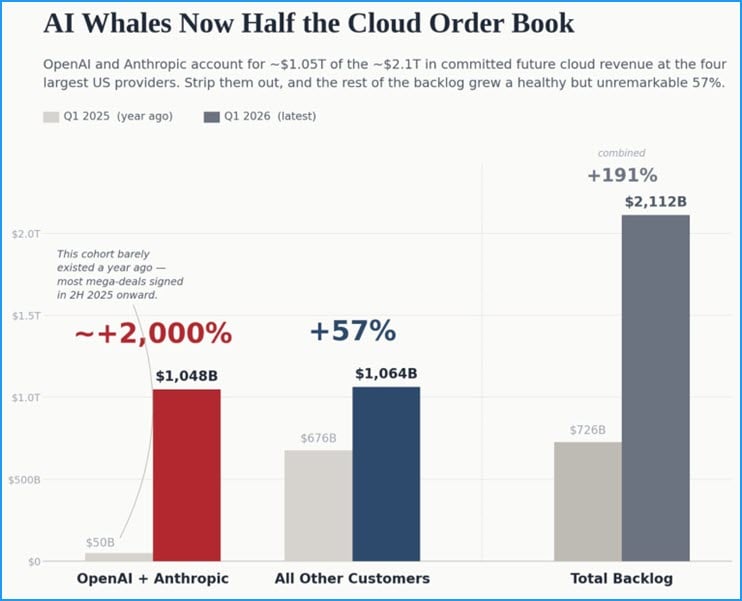
Both companies are burning cash. Neither even has revenues anywhere close to the committed amounts. Both would have to 10x their revenues and profitability in just a couple of years for any of this to pencil out.
Oh, did I mention that Deepseek v4 (the Chinese AI version) is open source and vastly cheaper to operate than either ChaptGPT or Claude? How does one significantly raise revenue under those circumstances?
Finally, Paul and I discussed the fact that the stock market’s internals are throwing off highly conflicting signals.
On the one hand, earnings have smashed all expectations. That’s bullish.
On the other hand, market breadth is terrible as is the advance-decline data, which saw decliners outnumber advancers for four out of the last five closing index record highs.
So which is it? Will the real stock market please raise its hand?
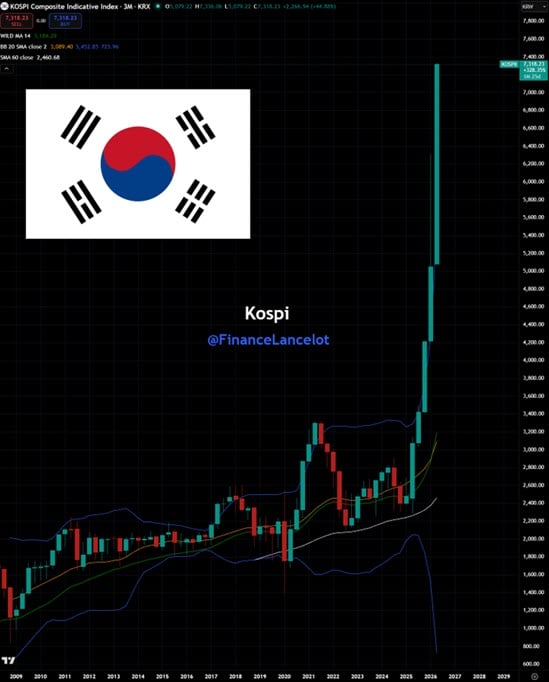
As a couple of guys with some gray hairs, we both feel like we’ve been here and seen this before. This chart of the South Korean stock market (the “KOSPI” index), representing a country that’s absolutely reeling under the energy shock, pretty much sums it up:
LOL!
That’s a blow off top if ever we’ve seen one. Either that or fiat money is about to get torched in a serious way. Either way, not a good sign, more of an omen.

Timestamps
00:00 The Narrative War in Financial Markets
09:09 The Emotional Rollercoaster of Investing
20:43 The Dangers of Overconfidence and Arrogance
23:52 The Blow-Off Top Phenomenon
32:08 The Disconnect Between Reality and Market Behavior
37:13 Political Influence on Market Sentiment
39:26 Economic Pressures on Households
41:50 Investment Strategies in Uncertain Times
43:54 The Tale of Two Markets
46:08 Market Breadth and Underlying Weakness
48:12 The Role of AI in Market Valuations
53:46 Economic Indicators and Market Signals
01:00:07 The Importance of Prudence in Investing
01:16:33 The Jaws of Market Dynamics
01:18:38 The AI Revenue Dilemma
01:21:37 The Impact of AI on Employment
01:25:43 The Mirage of Future Profits
01:28:39 The Consumer’s Financial Strain
01:29:44 The Inflationary Spiral
01:35:06 Corporate Deception and Trust Issues
01:39:37 The Erosion of Morality in Business
01:41:26 The Future of Capitalism and Society
FINANCIAL DISCLAIMER:
The information contained in this video and the resources available for download through our affiliated website are not intended as and shall not be understood or construed as financial advice, nor should be interpreted as a solicitation to sell or offer to sell investment advisory services. No person who currently works for or contracts with Peak Prosperity or Peak Financial Investing is an attorney or accountant, nor are we holding ourselves out to be, and the information contained in the video and on the website is not a substitute for legal or tax advice from a professional who is aware of the facts and circumstances of your individual situation. While Peak Financial Investing is a registered investment advisor, please note that this podcast is not intended to be investment advice.
All information has been obtained from sources believed to be reliable, but its accuracy is not guaranteed. There is no representation or warranty as to the current accuracy, reliability or completeness of, nor liability for, decisions based on such information and it should not be relied on as such. We have done our best to ensure that the information provided is accurate and provides what we feel is valuable information. The views expressed are subject to change based on market and other conditions.<
No guests or clients appearing on the podcast receive any form of compensation for their appearance and obtained no other benefit from either Peak Prosperity or Peak Financial Investing.
All investing involves risks including the possible loss of capital. Asset allocation and diversification does not ensure a profit or protect against loss. Please note that out- performance does not necessarily represent positive total returns for a period. There is no assurance that any investment strategy will be successful. All investments carry a certain degree of risk. Dividends are not guaranteed, and a company’s future ability to pay dividends may be limited.
Additional important disclosures for Peak Financial Investing may be found in our Form ADV Part 2A, which can be found at https://adviserinfo.sec.gov/firm/summary/319672.
 by flyingdoc