


There’s no escaping the economic damage that’s on the way.
Full confession – mea culpa! – I thought that the closing of the Strait of Hormuz would have been a big deal. But so far, the oil markets have shrugged it off, and other expected difficulties have not emerged due to the loss of helium, fertilizer, sulfur and petroleum products.
So what gives? Where are we actually in this story, and what comes next?
If I’m wrong, I guess nothing happens. Oil remains both relatively cheap and abundant and stocks just go higher every week and month forever.
If I’m right, the US and the world slam into an oil shortage that will destroy the global economy and shred financial systems. At a minimum, the world would plunge into a decline as large as the Great Depression. At worst, the economy shrinks by half.
Either I’m very wrong, or I am really right.
Energy – Stocks and Flows
But, you know me, I am a numbers guy. I like data. I prefer have a foot in the real world over living entirely in a world of abstractions. So let’s look at the data.
Let’s begin with oil. It’s a wildly complex subject if you get into all the many details. But it’s also a simple subject when viewed from 30,000 feet. Oil comes out of the ground, it is piped to a storage tank, it is refined into many things, and then those things are set on fire. This happens 24x7x365.
The ‘stocks’ in this example are the storage tanks (and sometimes caverns) while the ‘flows’ are the daily production figures.
Natural gas (NG) and natural gas liquids (NGL) follow the same path. Extraction then storage then they are consumed.
Hydrocarbons come out of the ground, stored for a bit, then burned to perform useful work (or converted into products like fertilizer, asphalt, or plastics).
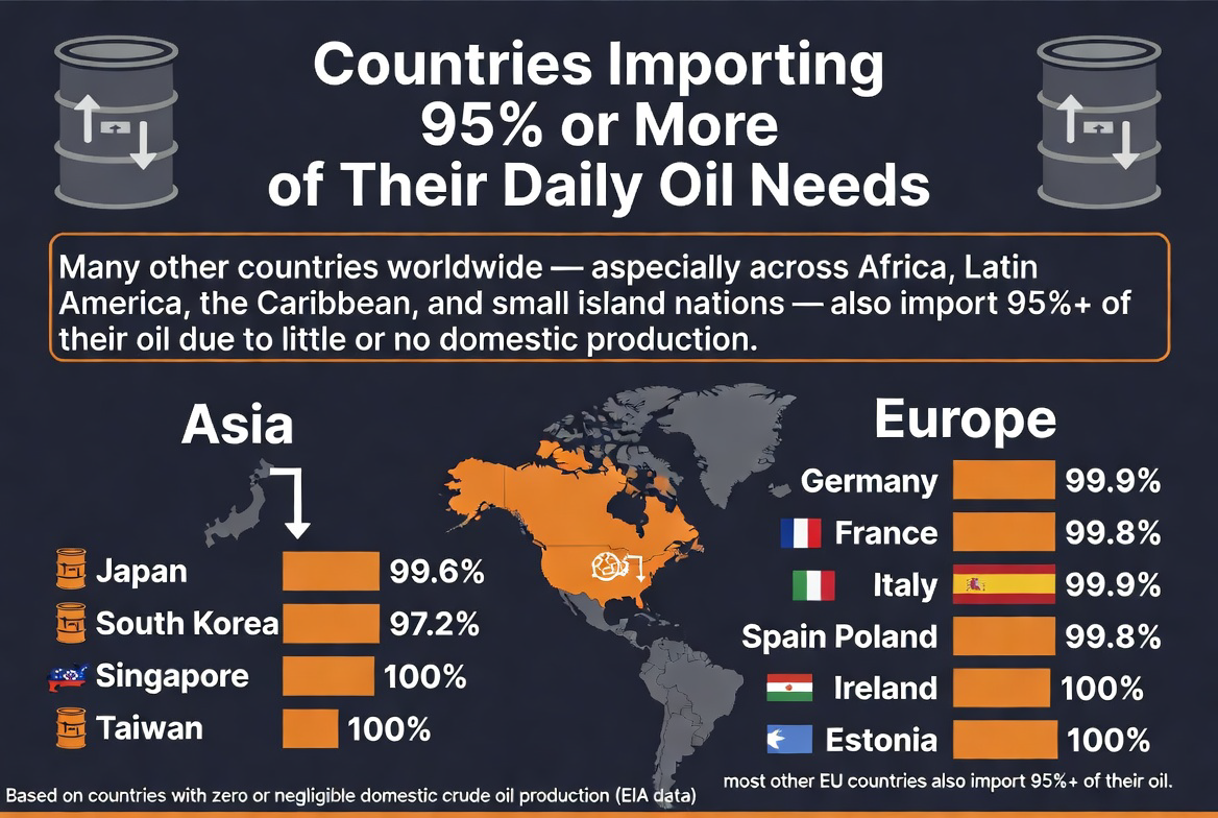
Every nation consumes oil. Every nation has to carefully balance its stocks and flows. Many nations produce no oil of their own, and their ‘flows’ are effectively completely dependent on the constant and persistent inbound movement of oil across their borders.
These 11 countries are effectively completely dependent on imported oil.
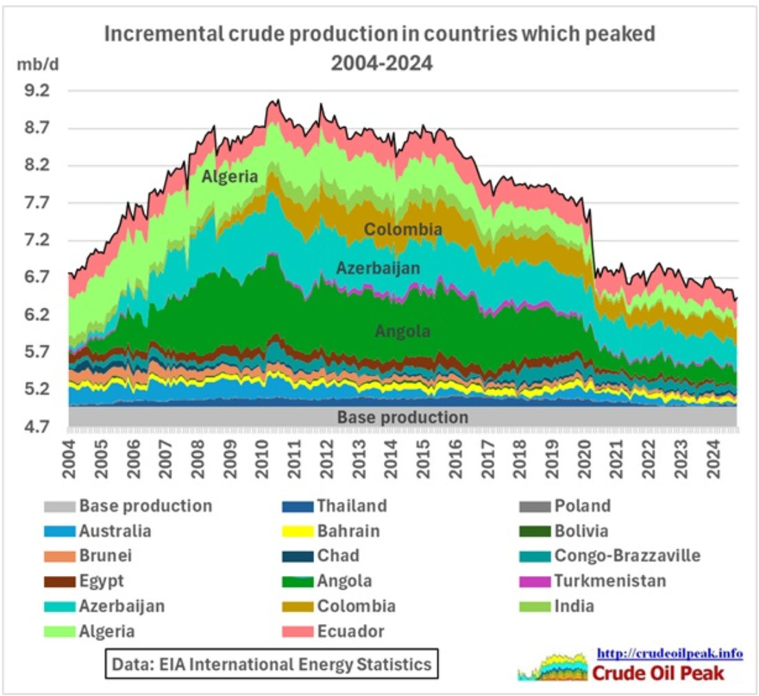
The problem with oil is that it depletes. Here’s a group of 16 countries that are past their peaks of oil production. Given that trend has been in pace for 15+ years, it seems to be a terminal condition.
Every nation begins to fret if or when their oil flows are even modestly disrupted, and for good reason. A shortage of diesel means having to ration heavy transport for vital goods. A shortage of gasoline hits consumers hard, disrupting commutes and daily plans. A shortage of jet fuel means fewer flights.
If that goes on for too long, then the economy will be forced into retreat to match the amount of oil available. This is the most robust chart in all of economics:
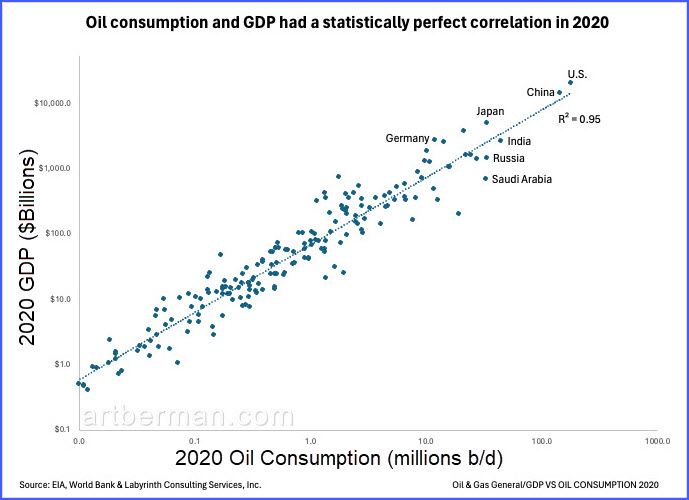
Larger economies consumer more oil than smaller economies. It’s as straight a line as you will ever find in this business. More economy equals more oil consumed. Full stop.
Which means the converse is equally true. Less oil (due to shortages) will translate into less economy.
How much less?
Well let’s first strip away some of the ‘gunk’ from the world oil figures. I only count true Crude Oil + oil Condensate (i.e. “C+C”) as actual oil. The US and international energy agencies began adding in other things such as NGL’s into the reported oil demand and supply figures a few years back, and I prefer to strip them out.
Why? Nobody runs an airplane or a ship on butane (on of the NGLs).
Oil is THE master resource. End of story.
On that basis we find that the world was producing (and eventually consuming) 84.4 million barrels per day in 2025.
If we strip away 10 million barrels per day as the amount lost from the Persian Gulf due to the blockage of the Strait of Hormuz, we can then ask, at what earlier time in history was the world consuming 74.4 million barrels per day?
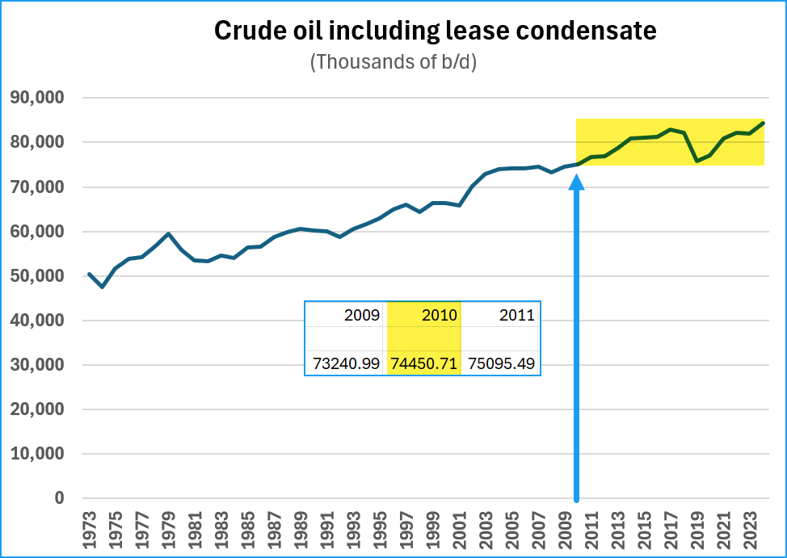
The inset box in the above chart shows that in 2010 the world consumed 74.4 million barrels per day.
Which brings us to the next question; “How much smaller was the global economy in 2010 as compared to today? Well, on a real basis (this is, inflation adjusted to compare apples to apples) it was ~50% smaller than today.
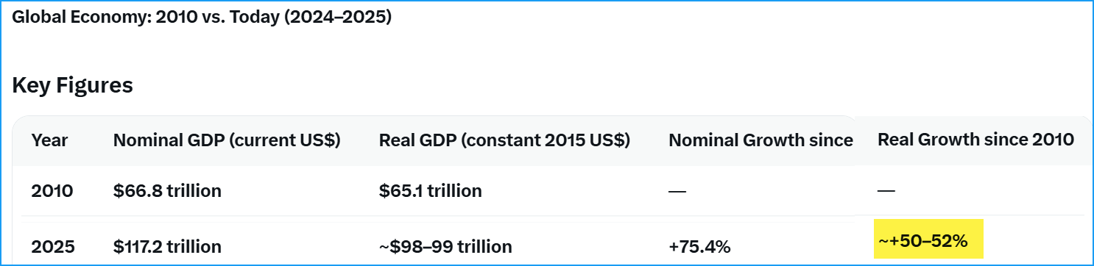
What?!?
Could the global economy fall that much? I suppose that’s possible if things escalate further from here and the Strait of Hormuz remains effectively closed for another 6-12 months. I suspect there’s some efficiencies in GDP that have built up over the years which could soften the blow but even if the decline is ‘only’ half that, it would be a larger insult to the global economy than the Great Depression.
Further, I have to speculate that our debt-fueled approach to ‘growing’ the economy (in quotes because I think debt should be backed out of official growth figures, especially government debt) could really prove problematic. Remove the debt growth and a whole lot of supposed economic growth suddenly evaporates.
As followers of my work know well, our system of debt-based money works pretty well while debts are growing, but absolutely throws a hissy fit and threatens to collapse when credit growth slips into reverse, as it did between 2009 and 2010.
So please get ready. If I am right and oil is actually important to the world economy, then everybody needs to be prepared for a severe global economic shock, and the near certainty of a massive financial crisis.
Part of my certainty about being right, besides my solid grounding in facts and physics, is because what is unfolding appears to be intentional. And if that’s the case, then there’s not going to be any peace deal, we’ll see the resumption of military actions and escalations, and yet more damage to Gulf energy facilities.

 by jimid