


Good news, inflation cooled down in June, bad news the government is still fabricating inflation numbers that simply don’t track your actual shopping experiences.
Officially, according to the BLS, the June inflation reading was 3.5%:
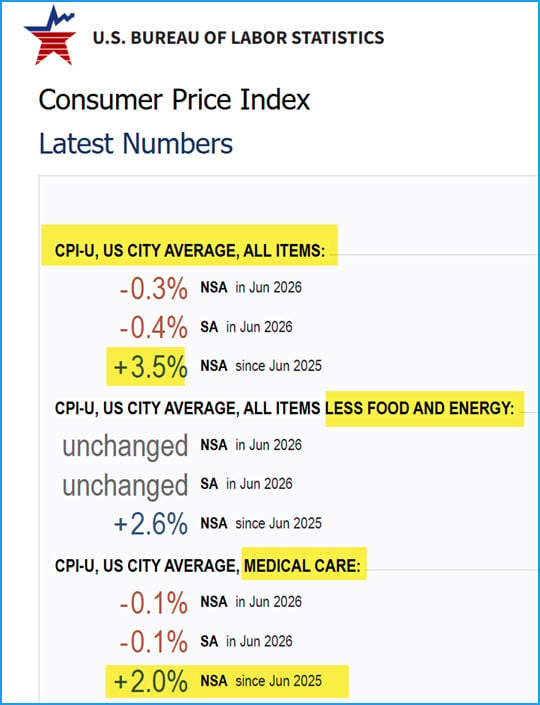
According to the BLS, ‘medical inflation’ was only 2.6% yr/yr, but you may have noticed, as Paul and I did, that our health insurance premiums went up considerably more than that.
This is as good a place as any to expose the ridiculous lengths to which the BLS goes to hide the true inflationary impact that is primarily caused by government deficit spending.
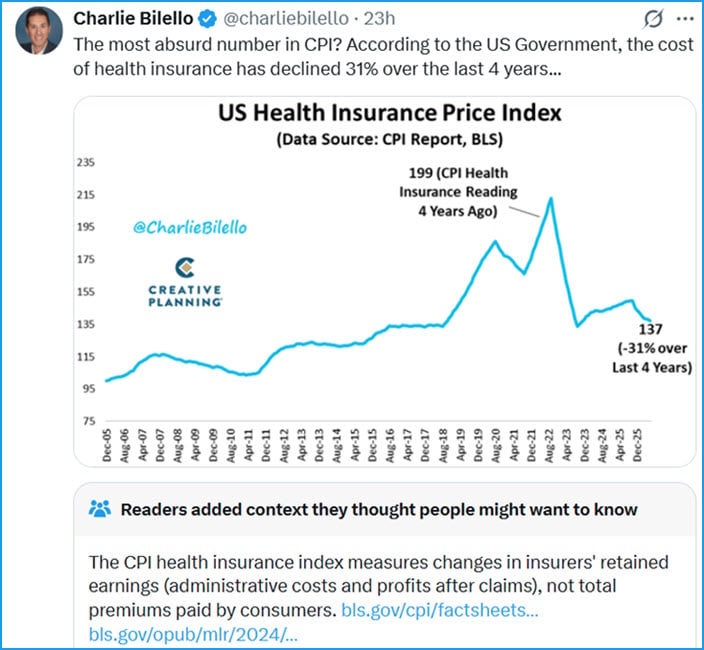
As Charlie Bilelo notes, according to the BLS, health insurance costs have declined by 31% over the past 5 years:
LOL!
As a proposed community note revealed, the way the BLS ‘calculates’ your health insurance costs is by using the profits of health insurance companies as a proxy for health insurance costs.
I’m sure somebody could make an argument for that, but if that method results in the preposterous claim that health insurance costs have gone down by 31% over five years, then it’s a really dumb method that needs to be chucked.
Further, the BLS severely underweights health insurance at just 0.89% of the average monthly ‘basket’ of spending.
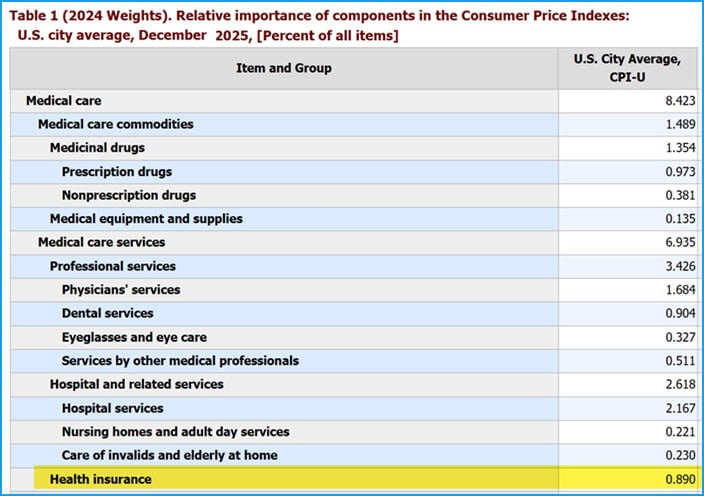
In reality, for many families, health insurance is higher than their mortgage or rent payments.
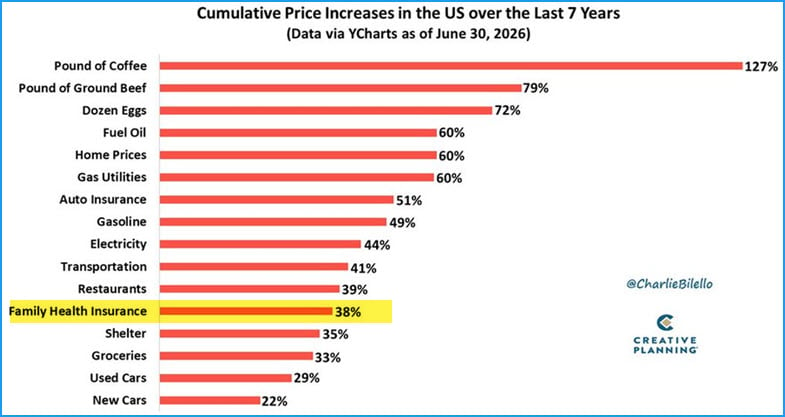
I know what you’re thinking; why not just track the actual prices of health insurance instead? That would be defensible and smarter than using a janky proxy like HC profits which can be rigged and jiggered six ways to Sunday.
On that basis, health insurance costs are up 38% over the past 7 years.
The summary here is that inflation, while having moderated somewhat according to the BLS, remains well above the Fed’s official target rate of 2%.
And it’s probably going higher…
Future Inflation
The headwaters of the inflationary Nile, is government deficit spending.
June was yet another whopper of a month for the US government deficit clocking in at $120 billion. June is usually a very light deficit month because it’s when estimated tax payments are due.
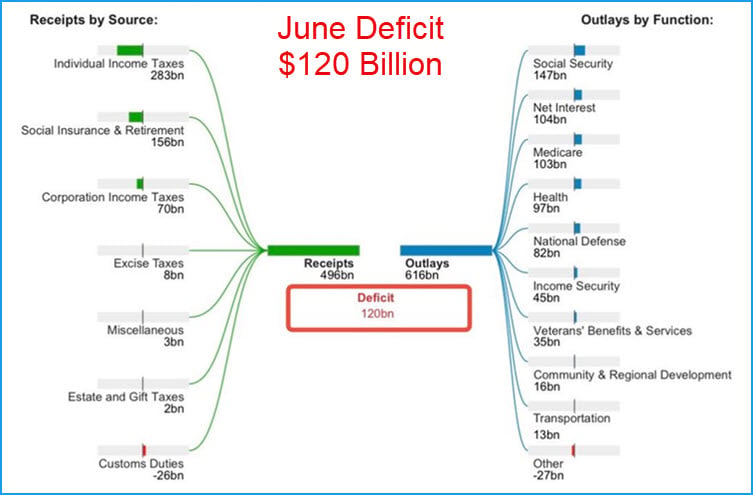
But the true deficit is probably even higher than that. The government is projecting a deficit of $2 trillion, but the actual amount of new debt the US government took on over the past 12 months is $3.2 trillion.
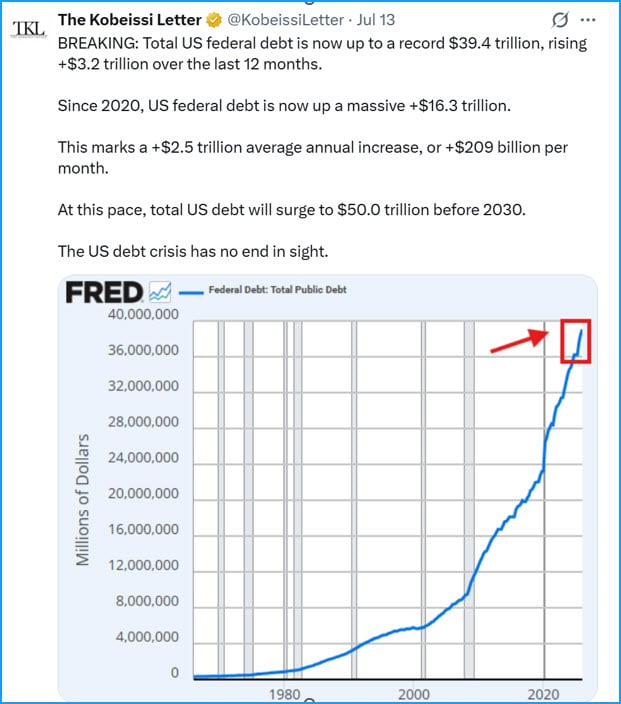
I know the calendar year and fiscal year are off by a few months, but are they off by $1.2 trillion? Not a chance.
So, on top of Federal Reserve money printing (+$200 billion since December 25) and government deficit spending, we also have the never-ending war with Iran which has, again, dialed up in kinetic intensity this prior week.
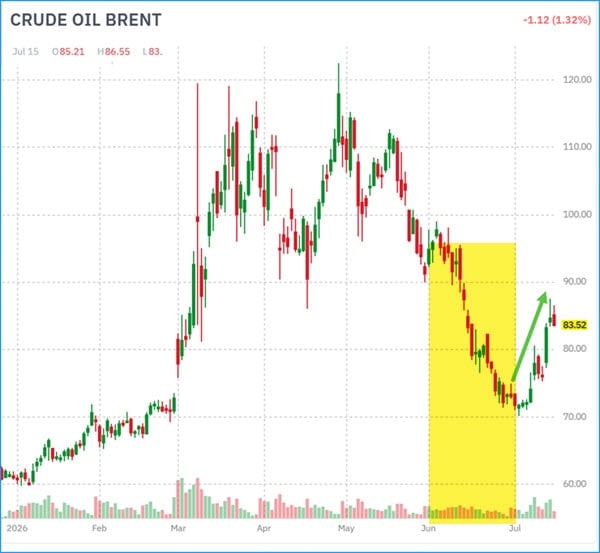
A big reason inflation fell in June is because the price of oil fell significantly in June (yellow highlight). But it’s been moving higher in July…and I expect it will move a LOT higher over the coming months, especially if Trump escalates from here.
Creak! Pop!
Paul and I also discussed the South Korean KOSPI stock index which has undergone a powerful -31% ‘correction’ over just 17 days.
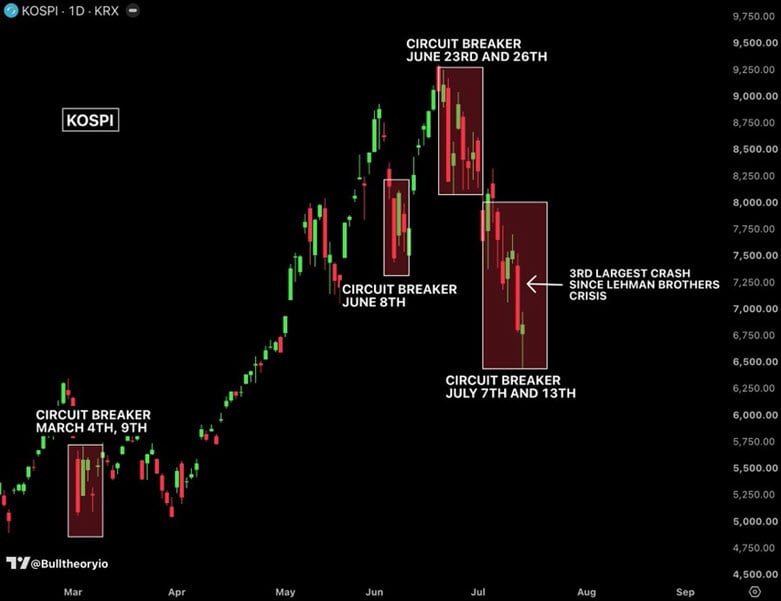
Recalling that events tend to spread from the outside-in, the KOSPI provides a warning signal, as does the yen rapidly weakening, and bonds stubbornly selling off.
As is typical of us, Paul and I both urge prudence. Prepare for the downside while the skies are still relatively blue, focus on resilience, and avoid over-reliance on passive strategies.
Until next time….

Timestamps
00:00 Introduction and Disclaimer
01:07 Inflation Trends and Health Insurance Costs
05:51 The Flawed Measurement of Inflation
11:51 Market Reactions and Economic Pressures
17:56 Investment Strategies in Uncertain Times
24:09 Government Spending and Future Inflation Risks
25:51 Navigating Social Security Changes
29:05 The Impact of Government Spending on Inflation
33:57 The Consequences of Military Spending
37:42 Energy Markets and Inflation Dynamics
42:03 Geopolitical Tensions and Oil Supply
49:36 Market Signals and Economic Indicators
55:21 Market Complacency and Risk Management
58:42 Historical Lessons and Preparing for Market Downturns
01:01:28 Global Market Signals and Emotional Investing
01:04:26 Navigating Market Volatility and Emotional Pain
01:10:22 Understanding Market Cycles and Future Risks
01:17:35 The AI Bubble and Future Economic Trends
FINANCIAL DISCLAIMER:
The information contained in this video and the resources available for download through our affiliated website are not intended as and shall not be understood or construed as financial advice, nor should be interpreted as a solicitation to sell or offer to sell investment advisory services. No person who currently works for or contracts with Peak Prosperity or Peak Financial Investing is an attorney or accountant, nor are we holding ourselves out to be, and the information contained in the video and on the website is not a substitute for legal or tax advice from a professional who is aware of the facts and circumstances of your individual situation. While Peak Financial Investing is a registered investment advisor, please note that this podcast is not intended to be investment advice.
All information has been obtained from sources believed to be reliable, but its accuracy is not guaranteed. There is no representation or warranty as to the current accuracy, reliability or completeness of, nor liability for, decisions based on such information and it should not be relied on as such. We have done our best to ensure that the information provided is accurate and provides what we feel is valuable information. The views expressed are subject to change based on market and other conditions.<
No guests or clients appearing on the podcast receive any form of compensation for their appearance and obtained no other benefit from either Peak Prosperity or Peak Financial Investing.
All investing involves risks including the possible loss of capital. Asset allocation and diversification does not ensure a profit or protect against loss. Please note that out- performance does not necessarily represent positive total returns for a period. There is no assurance that any investment strategy will be successful. All investments carry a certain degree of risk. Dividends are not guaranteed, and a company’s future ability to pay dividends may be limited.
Additional important disclosures for Peak Financial Investing may be found in our Form ADV Part 2A, which can be found at https://adviserinfo.sec.gov/firm/summary/319672.

 by randommike